











 Contact
 Access Map


Assistant Professor Mayumi Hatakeyama, Professor Takuya Kitaoka and their international collaborative research team have achieved immune activation and modulation using wood‑derived nanofiber‑stabilized emulsions
A new immunomodulatory adjuvant using cellulose nanofibers derived from trees
Points
- The use of safe and reliable adjuvants*1 is essential for enhancing the effectiveness of vaccines and immunotherapies.
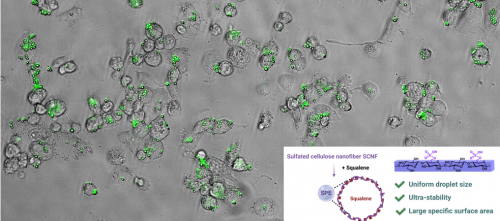
- By chemically modifying the surface of wood-derived cellulose nanofibers (cellulose nanofiber: CNF*2), the researchers prepared oil-in-water emulsions and successfully activated and modulated immune responses in human liver cancer cells and macrophages.
- This system also enables highly efficient antigen loading and the induction of cell-type-specific immune responses, offering strong potential for application as a novel medical modality for next-generation immunotherapies.
Abstract
Advances in infectious disease control and cancer immunotherapy have brought significant global attention to "immune adjuvants", which maximize the effectiveness of vaccines and immunotherapeutic treatments. Conventional adjuvants often consist of emulsions stabilized with inorganic aluminum salts or petroleum-derived surfactants, and there has been a growing need for novel adjuvants that can induce and modulate immune responses more safely and more effectively.
In this study, we prepared oil-in-water Pickering emulsions*3 by using wood-derived cellulose nanofibers (CNFs) as solid surfactants, and successfully achieved the activation and modulation of immune responses in human liver cancer cells and macrophages.
A collaborative research team consisting of Associate Professor Qi Li from Hubei University (China) and Assistant Professor Mayumi Hatakeyama and Professor Takuya Kitaoka from the Faculty of Agriculture, Kyushu University has successfully prepared highly stable emulsions by chemically modifying the crystalline surface of wood-derived CNFs, which have no intrinsic immunoactivity. The team discovered that this modification induces phenomena in which immune responses are either enhanced or suppressed.
Furthermore, this CNF-stabilized emulsion not only enables highly efficient antigen loading but also induces distinct immune responses depending on the cell type, demonstrating substantial potential for the emulsion as a novel adjuvant modality for next-generation immunotherapies.
These findings open a new pathway for the development of immune adjuvants using safe, plant-derived natural materials. They hold strong promise for broad applications across various medical fields, including vaccine development and cancer immunotherapy.
This research was published online in the academic journal Chemical Engineering Journal, issued by Elsevier, on Thursday, January 8, 2026.
Researcher's Comment
This study focuses on the amphiphilic nature of cellulose nanofibers derived from forest resources, and demonstrates that utilizing these nanofibers as emulsifiers allows for the development of emulsions that can activate and modulate immune responses. Natural structural polysaccharides are not only abundantly available but also cannot be artificially synthesized, highlighting their unique value as biomaterials. These findings open new possibilities for biomedical research that harnesses the intrinsic power of nature. (Takuya Kitaoka)
Glossary
*1 Adjuvant
An immunostimulatory agent added to vaccines to enhance or modulate immune responses that cannot be sufficiently induced by the antigen alone. In recent years, adjuvants have also garnered attention for their potential use in therapeutic vaccines, including those for cancer immunotherapy.
*2 Cellulose nanofiber (CNF)
A naturally derived nanoscale material produced by refining cellulose-the primary structural component of plants such as trees and grasses-down to the nanometer range (one nanometer is one-billionth of a meter). CNFs possess desirable material properties such as light weight, high strength, a large specific surface area, and low thermal expansion. In recent years, CNFs have also drawn considerable attention as promising biomaterials.
*3 Pickering emulsion
An emulsion stabilized not by molecular surfactants such as soaps, but by nanoscale solid particles that act as interfacial stabilizers. Pickering emulsions are known for their extremely high stability.
Publication Information
Journal: Chemical Engineering Journal
Title: Biointerface engineering of cellulose nanofibers to design immunomodulatory Pickering emulsion microparticles
Authors: Qi Li, Mayumi Hatakeyama, Takuya Kitaoka
DOI:10.1016/j.cej.2026.172799
- For more details on this research, click here.
For Research-related inquiries