











 Contact
 Access Map


Research group led by Professor Syuntaro Hiradate elucidates the mechanism behind increased soil CO₂ emissions during drying-rewetting cycles
Metal-organic interactions identified as a key factor in carbon cycling, improving predictions under climate change
Points
- Examining the effects of drying-rewetting cycles on soil CO₂ emissions in surface soils and buried humic horizons from Hokkaido
- In buried humic horizons in particular, the increase in CO₂ emissions induced by drying-rewetting cycles exceeded the amount expected from microbial biomass (Note 1)
- Potential contribution of the disruption of reactive metal-organic complexes (Note 2), a key mechanism for soil carbon stabilization, to enhanced soil CO₂ emissions
Abstract
The global annual amount of carbon dioxide (CO₂) released through the microbial decomposition of soil organic carbon (Note 3) is estimated to be approximately five times greater than anthropogenic CO₂ emissions, highlighting the importance of understanding how climate change affects soil CO₂ emission dynamics.
A research group consisting of Assistant Professor Hirohiko Nagano and doctoral student Yuri Suzuki of the Faculty of Agriculture and Graduate School of Science and Technology, Niigata University, together with Professor Syuntaro Hiradate of the Faculty of Agriculture, Kyushu University, and researchers from Okayama University, the Forestry and Forest Products Research Institute of the National Research and Development Agency Forest Research and Management Organization, Tohoku University, the Acid Deposition and Oxidant Research Center, and Hokkaido University, conducted laboratory incubation experiments using surface soils and buried humic horizons collected from forests in Hokkaido. Buried humic horizons are former surface soils that became buried in deeper layers as a result of past volcanic ash deposition.
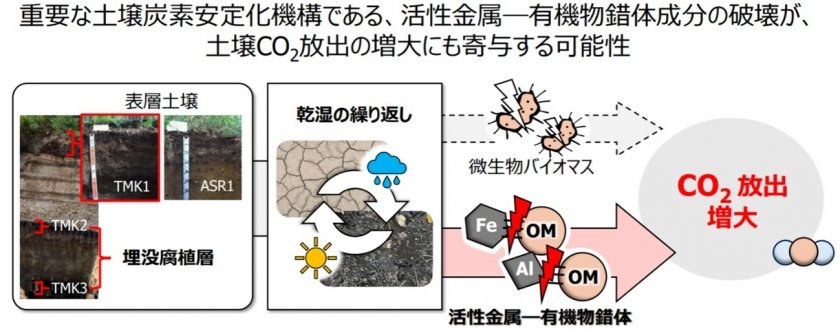
The results demonstrated that repeated cycles of extreme drying and rewetting, conditions that are expected to become more frequent as climate change increases the occurrence of extreme weather events such as heavy rainfall and drought, substantially increased CO₂ emissions from the soils. In particular, in buried humic horizons, the increase in CO₂ emissions was far greater than could be explained by microbial biomass (Note 1), suggesting that drying-rewetting cycles may accelerate the breakdown of reactive metal-organic complex components (Note 2), which have traditionally been regarded as an important mechanism for stabilizing soil carbon.
These findings support the research group's previous study published in 2025 (Note 4) and are expected to contribute to more accurate predictions of carbon cycling under climate change, where considerable uncertainty remains, as well as to improved projections of future global environmental change.
Figure 1. Proposed mechanism underlying enhanced soil CO₂ emissions induced by drying-rewetting cycles
Glossary
Note 1. Microbial biomass
The amount of organic matter present in soil in the form of living microorganisms. Although microbial biomass typically accounts for only about 1% of total soil organic carbon, it serves as an important source of nutrients available to plants. As such, it has long been studied as one of the key indicators of soil fertility in agricultural production systems.
Note 2. Reactive metal-organic complexes
Reactive metal-organic complexes (Note 2), a key mechanism for soil carbon stabilization, to enhanced soil CO₂ emissions are soil constituents composed primarily of soil organic matter bound to highly reactive metals, particularly aluminum and iron. They are operationally defined as the fraction extractable with a sodium pyrophosphate solution. In volcanic ash soils (Andosols), which are widely distributed throughout Japan, these components are considered one of the principal mechanisms responsible for the long-term stabilization and accumulation of high concentrations of organic carbon in the soils.
Note 3. Soil organic carbon
Globally, the amount of organic carbon stored in soils is estimated to be three to four times greater than the carbon contained in terrestrial vegetation and two to three times greater than the amount of carbon in the atmosphere. As such, soil organic carbon constitutes the largest carbon pool in terrestrial ecosystems.
Note 4. Previous study published in 2025
Suzuki, Y., Hiradate, S., Koarashi, J., Atarashi-Andoh, M., Yomogida, T., Kanda, Y., & Nagano, H. (2025). Comprehensive increase in CO₂ release by drying-rewetting cycles among Japanese forests and pastureland soils and exploring predictors of increasing magnitude. SOIL, 11(1), 35-49. https://doi.org/10.5194/soil-11-35-2025
This study conducted soil incubation experiments using ten soil samples collected across Japan and demonstrated that drying-rewetting cycles increased CO₂ emissions in all soils examined. The study also found that soils containing larger amounts of reactive metal-organic complexes exhibited greater increases in CO₂ emissions in response to drying-rewetting cycles.
(See also: Kyushu University press release, January 21, 2025, "Drying and rewetting cycles increase soil CO₂ emissions.")
Publication Information
This research was published on September 4, 2026 (UTC) in Progress in Earth and Planetary Science (PEPS), a scientific journal of the Japan Geoscience Union (JpGU).
Title: An evaluation on contribution of organo-metal complexes to enhanced soil CO₂ release during drying-rewetting cycles using buried humic horizon soils
Authors: Yuri Suzuki, Syuntaro Hiradate, Jun Koarashi, Mariko Atarashi-Andoh, Kazuki Suzuki, Masataka Nakayama, Yukiko Abe, Kouki Hikosaka, Hirofumi Kajino, Hiroyuki Sase, Rieko Urakawa, Hirohiko Nagano
【doi】10.1186/s40645-026-00843-6
- For more details on this research, click here.
For Research-related inquiries