











 Contact
 Access Map


Research group led by Professor Fumihiko Tanaka has developed a self-healing smart freshness sensor material using natural pigments.
Visualizing food freshness through color; expected to contribute to reducing food loss as IoT-enabled packaging
Points
- Food waste is a global issue, and accurately assessing freshness is critically important. Conventional methods often require specialized analytical instruments, creating a demand for simple indicators that can be used in everyday settings.
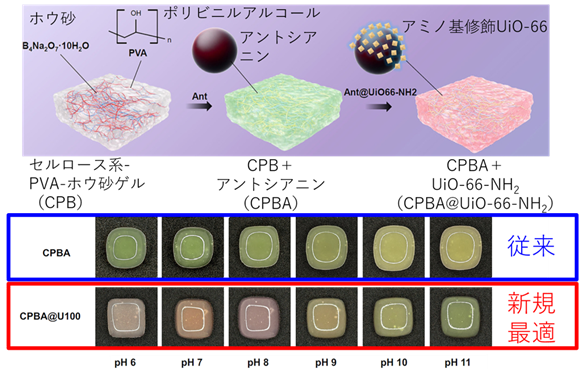
- In this study, the natural pigment anthocyanin (Note 1) was immobilized in a metal-organic framework (MOF) (Note 2) to improve its stability. Furthermore, by combining it with a self-healing hydrogel, a smart material with both durability and functionality was developed.
- Future efforts will focus on miniaturizing the sensor and establishing mass production, with the aim of implementing it in food packaging. In addition, integration with IoT is expected to enable real-time quality management technologies throughout the distribution process.
Abstract
Conventional methods for easily assessing food freshness have been limited, making it difficult to accurately determine quality deterioration. In particular, although sensor materials based on color changes are considered promising, natural pigments are highly sensitive to light and temperature, making long-term stable use challenging.
A research group led by Professor Fumihiko Tanaka and Associate Professor Fumina Tanaka of the Faculty of Agriculture, Kyushu University has successfully developed a new smart material capable of visualizing food freshness in real time. In this study, the natural plant-derived pigment anthocyanin was immobilized within a porous material known as a metal-organic framework (MOF), significantly improving the instability that has traditionally been a major challenge for such pigments. This approach enabled the realization of a stable sensing material that is less affected by light and temperature. Furthermore, by incorporating this material into a cellulose-derived hydrogel, the researchers developed a self-healing smart material. This material is capable of molecular-level recombination after damage, allowing it to recover both its mechanical strength and functionality.
The developed material exhibits continuous color changes in response to pH variations and ammonia generated during food spoilage. In storage tests using pork, the observed color changes showed a strong correlation with freshness indicators such as pH and total volatile basic nitrogen, confirming that the state of food deterioration can be intuitively assessed.
These results are expected to contribute to advanced food quality management and to the development of next-generation smart packaging technologies that help reduce food loss.
The findings were published in the academic journal Chemical Engineering Journal on May 5, 2026.
Figure
Researcher's Comment
By combining natural materials with nanomaterials, we aimed to realize a smart material that achieves both safety and functionality. We will continue to advance research toward practical applications that contribute to reducing food loss. (Fumihiko Tanaka)
Glossary
(Note 1) Anthocyanin: a natural pigment found in plants that exhibits color changes depending on pH
(Note 2) Metal-organic framework (MOF): a material with fine pores capable of stably retaining molecules
Publication Information
Journal: Chemical Engineering Journal
Title: Self-Healing Cellulose-based Hydrogel Smart Packaging Embedded with Anthocyanin-Immobilized Metal-Organic Frameworks for Food Preservation and Freshness Monitoring
Authors: Fanze Meng, Xirui Yan, Fumina Tanaka, Fumihiko Tanaka, et al.
DOI:10.1016/j.cej.2026.176764
- For more details on this research, click here.
For Research-related inquiries
Fumihiko Tanaka, Professor
Fumina Tanaka, Associate Professor