











 Contact
 Access Map


Research group led by Professor Fumihiko Tanaka envisions a future of intelligent food packaging
Proposing a research roadmap for next-generation food packaging equipped with AI and self-healing capabilities
Points
- Approximately one-third of all food produced worldwide is discarded, making the reduction of food loss and the assurance of food safety major global challenges.
- In this study, the researchers proposed the concept of "Future-Ready Food Packaging," which integrates intelligent packaging that can monitor food freshness, self-healing packaging that can recover its functionality after damage, and AI-powered technologies for predicting food quality.
- In the future, this approach is expected to enable more advanced real-time monitoring of food quality and more accurate shelf-life prediction, while also improving supply chain efficiency and helping to reduce food loss.
Abstract
Reducing food loss and improving food safety are major global challenges. However, most conventional food packaging systems are designed primarily for passive protection, shielding food from oxygen, moisture, light, and other external factors. As a result, they have limited ability to monitor changes in food quality or repair damage to the packaging itself. Consequently, there is a growing need for next-generation packaging technologies capable of monitoring food conditions in real time and supporting more effective distribution and quality management.
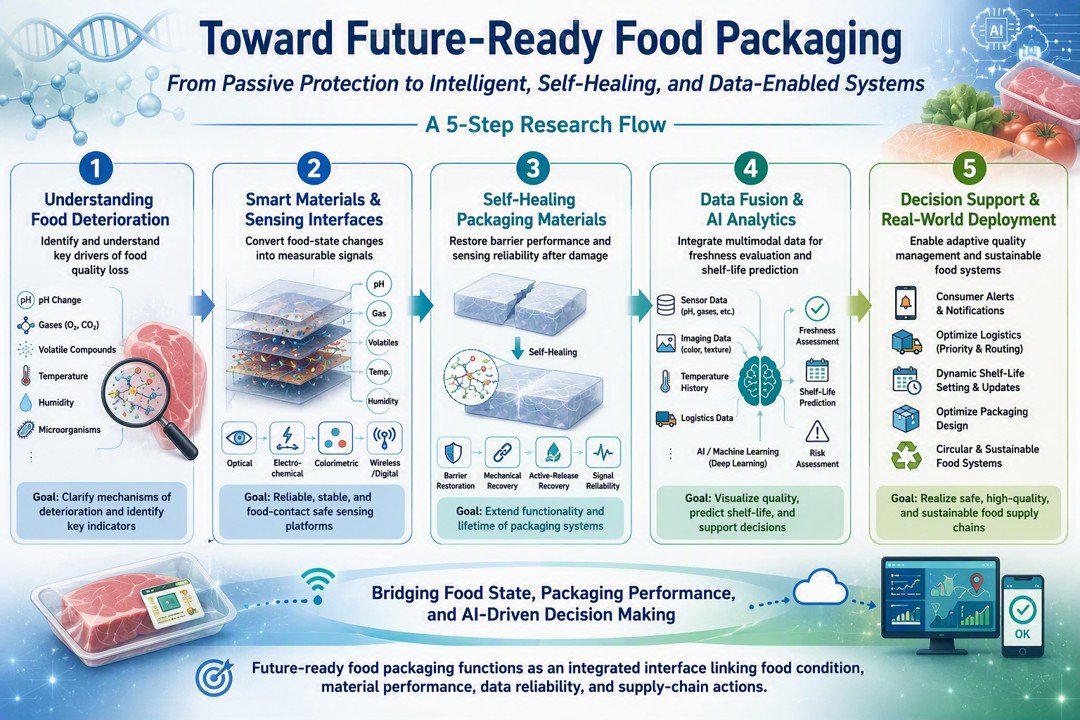
A research group led by Professor Fumihiko Tanaka and Associate Professor Fumina Tanaka of the Faculty of Agriculture, Kyushu University, conducted a comprehensive review of the latest advances in food packaging and proposed a new research concept termed "Future-Ready Food Packaging," which integrates intelligent packaging (Note 1), self-healing packaging (Note 2), and artificial intelligence (AI).
The researchers organized and synthesized studies on functional materials capable of detecting freshness and spoilage, self-healing materials that can restore functionality after damage, and AI-based technologies for freshness assessment and shelf-life prediction. Based on these advances, they outlined a future direction in which food packaging evolves into an intelligent information system.
This research is expected to contribute to reducing food loss, improving logistics efficiency, and supporting the development of sustainable food supply systems.
The study was published online in the international journal Trends in Food Science & Technology (Impact Factor: 17.4) on July 13, 2026.
Figure The future landscape of food packaging: from passive protection to intelligent information systems
Researcher's Comment
Food packaging is evolving from a simple protective material into an intelligent system capable of understanding the condition of food and providing valuable information. In this paper, we comprehensively reviewed the material technologies, self-healing technologies, and AI technologies required to achieve this transformation. Our future goal is to realize next-generation packaging technologies that can be applied in real-world food distribution environments.
(Fumihiko Tanaka)
Glossary
Note 1. Intelligent Packaging: Packaging systems that can detect and indicate information such as food freshness, temperature, and other quality-related parameters.
Note 2. Self-healing Packaging: Packaging materials that can autonomously repair scratches, cracks, or other forms of damage.
Publication Information
Journal: Trends in Food Science & Technology
Title: Toward Future-Ready Food Packaging: From Passive Protection to Intelligent, Self-Healing, and Data-Enabled Systems
Authors: Fanze Meng, Xirui Yan, Jiao Zeng, Amna Bibi, Xinrui Mao, Laras Putri Wigati, Tran Thi Van, Ata Aditya Wardana, Fumina Tanaka, Fumihiko Tanaka
DOI:10.1016/j.tifs.2026.105943
- For more details on this research, click here.
For Research-related inquiries
Fumihiko Tanaka, Professor
Fumina Tanaka, Associate Professor