











 Contact
 Access Map


Research group led by Professor Fumihiko Tanaka, Associate Professor Fumina Tanaka develops new technology to maintain tomato freshness using banana peels
Development of a freshness-preserving coating using compounds extracted from discarded banana peels
Points
- Proteins, polysaccharides, and lipids were efficiently extracted from discarded banana peels and utilized as food coating materials.
- A Sodium alginate coating incorporating banana peel-derived lipids significantly maintained the freshness of cherry tomatoes by reducing moisture loss and softening.
- The study is expected to provide a novel upcycling (Note 1) technology that transforms waste into high-value food preservation materials through the reuse of discarded banana peels.
Abstract
Worldwide, vast quantities of banana peels are discarded each year, making their effective utilization an important challenge. At the same time, food loss caused by the postharvest deterioration of fruits and vegetables has become a serious social issue.
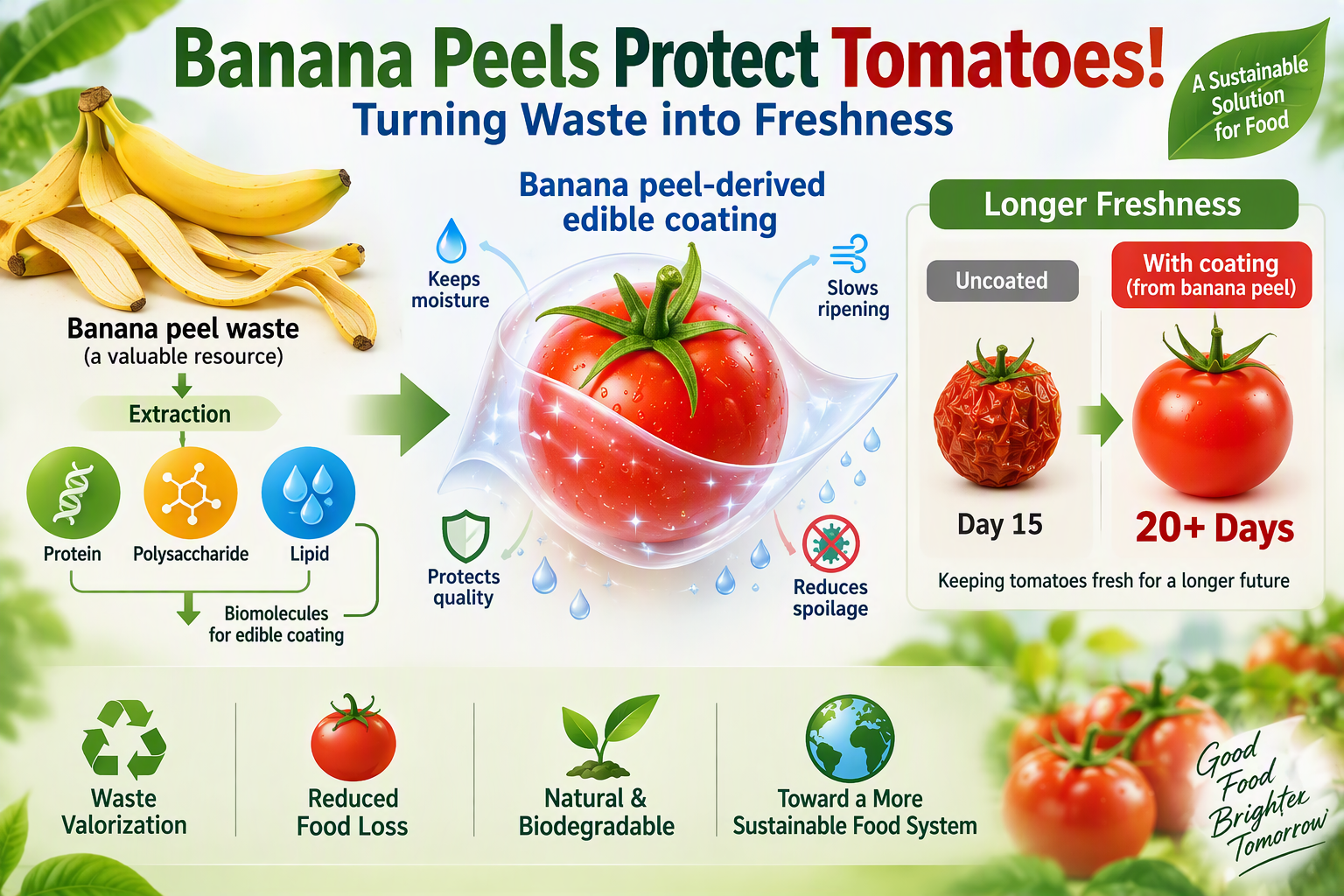
A research group led by Professor Fumihiko Tanaka and Associate Professor Fumina Tanaka of the Faculty of Agriculture, Kyushu University, developed edible coatings by extracting proteins, polysaccharides, and lipids from banana peels, which are normally discarded, and combining each fraction with sodium alginate (Note 2), a naturally derived polymer.
The researchers found that coatings containing banana peel-derived lipids exhibited particularly high moisture barrier properties. By suppressing weight loss, respiration rate, ethylene production, and softening in cherry tomatoes, the coating successfully extended the period during which market value could be maintained to more than 20 days.
This research is expected to contribute to the development of a sustainable food preservation technology that simultaneously promotes the high-value utilization of agricultural by-products and reduces food loss.
The results of this study were published in Food Bioscience on August 22, 2026 (local time).
Figure 1. Conceptual illustration of freshness preservation of cherry tomatoes using edible coatings incorporating banana peel-derived biomolecules.
Researcher's Comment
Banana peels have traditionally been treated as waste, yet they contain a variety of valuable compounds that can contribute to food preservation. In this study, we clarified the specific roles of different banana peel-derived fractions and demonstrated that the lipid fraction, in particular, provides superior freshness-preserving effects. We hope to further develop this technology as a sustainable solution that contributes to both food loss reduction and the circular use of resources. (Fumihiko Tanaka)
Glossary
Note 1. Upcycling
Upcycling refers to the process of transforming by-products or waste materials that would otherwise be discarded into new products or materials with added value. In this study, functional compounds were extracted from banana peels, which are typically treated as waste, and utilized to preserve the freshness of food products.
Note 2. Sodium Alginate
Sodium alginate is a natural polysaccharide derived from brown seaweeds such as kelp and wakame. Owing to its excellent biodegradability and safety, it is widely used in food films and edible coating materials for food applications.
Publication Information
Journal: Food Bioscience
Title: Fraction-specific regulation of barrier properties and postharvest physiology in alginate/cinnamaldehyde edible coatings incorporating banana peel waste-derived biomolecules for cherry tomato preservation
Authors: Jiao Zeng, Xirui Yan, Fanze Meng, Donghui Luo, Reshaka Kavindi Malawara Arachchige, Saki Ishiko, Fumina Tanaka, Fumihiko Tanaka
DOI:10.1016/j.fbio.2026.109756
For Research-related inquiries
Fumihiko Tanaka, Professor
Fumina Tanaka, Associate Professor