











 Contact
 Access Map


Research group led by Professor Fumihiko Tanaka develops high-performance food packaging from agricultural waste
Utilizing pumpkin peels to help extend freshness and reduce food loss
Points
- Food loss has become a global issue, and there is a growing demand for improved postharvest quality preservation technologies. At the same time, the effective utilization of agricultural waste remains a challenge, highlighting the importance of developing technologies that can address both issues simultaneously.
- In this study, carbon quantum dots (CQDs) (Note 1) were synthesized from pumpkin peels and incorporated into a biodegradable film (Note 2). As a result, mechanical strength, barrier properties, and antioxidant activity were significantly improved.
- In future work, we will optimize application conditions for different types of food and conduct safety evaluations toward practical implementation. With deployment envisioned within the next few years, expansion to industrial applications is expected.
Abstract
Postharvest losses of fresh produce are estimated to reach approximately 40-50% during distribution and storage, contributing significantly to food loss. In addition, conventional plastic packaging imposes a high environmental burden, creating a need for the development of sustainable alternative materials.
A research group led by Professor Fumihiko Tanaka and Associate Professor Fumina Tanaka at the Faculty of Agriculture, Kyushu University, has successfully developed a high-performance food packaging material by synthesizing nanomaterials known as carbon quantum dots (CQDs) from discarded pumpkin peels. In this study, CQDs with sizes of several nanometers were produced through hydrothermal treatment of pumpkin peels. These particles exhibit the ability to absorb ultraviolet light and possess antioxidant properties. Furthermore, by incorporating CQDs into a biodegradable film composed of carboxymethyl cellulose (CMC) and gelatin, a significant enhancement of material performance was achieved. The tensile strength of the film increased, while water vapor permeability decreased, effectively suppressing moisture transfer. In addition, the film demonstrated ultraviolet shielding capability and high antioxidant activity, indicating its potential to inhibit light exposure and oxidative reactions, both of which contribute to food deterioration.
In storage tests using cherry tomatoes, films containing CQDs suppressed microbial growth and reduced weight loss and softening, thereby maintaining freshness. Notably, films with 3% CQD content exhibited the highest preservation performance.
These findings are expected to contribute to sustainable food packaging and the reduction of food loss by achieving both the valorization of agricultural waste and the reduction of environmental impact.
This research was published on May 5, 2026, in the journal Food Research International.
Figure
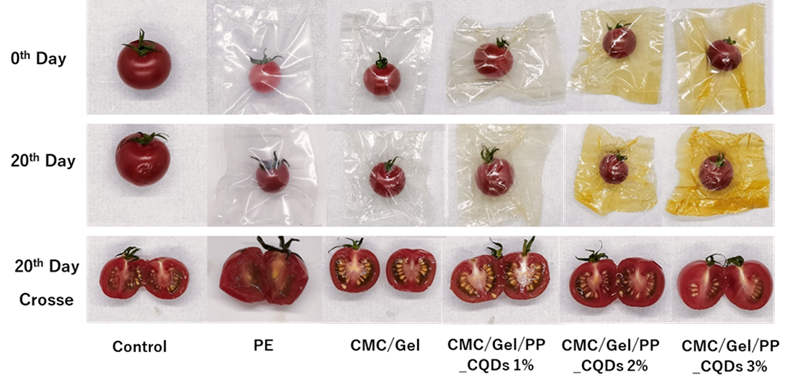
(Note) Control: no packaging; PE: polyethylene; CMC/Gel: CMC/gelatin film; CMC/Gel/PP_CQDs: pumpkin peel-derived CQD-incorporated films (1-3%). (Source, partially modified: Reshaka Kavindi et al., Food Research International (2026), CC BY 4.0)
Researcher's Comment
The key achievement of this study lies in the creation of high-performance materials from discarded agricultural resources and their successful application to food preservation. Moving forward, efforts will focus on establishing safety evaluation and manufacturing technologies for practical implementation.
(Fumihiko Tanaka)
Glossary
(Note 1) Carbon Quantum Dots (CQDs): carbon nanoparticles with sizes of several nanometers that exhibit optical properties and antioxidant activity
(Note 2) biodegradable film: a type of packaging material that can be decomposed in the environment
Publication Information
Journal: Food Research International
Title: Development of Active Food Packaging Using Carboxymethyl Cellulose/Gelatin Composites Reinforced with Carbon Quantum Dots Derived from Pumpkin Peel Waste
Authors: Reshaka Kavindi, Fumina Tanaka, Fumihiko Tanaka, et al.
DOI:10.1016/j.foodres.2026.119344
- For more details on this research, click here.
For Research-related inquiries
Fumihiko Tanaka, Professor
Fumina Tanaka, Associate Professor