











 Contact
 Access Map


Research group led by Professor Fumihiko Tanaka, Associate Professor Fumina Tanaka develops a smart sensor that lights up to indicate food freshness
Visualizing food freshness through dual colorimetric and fluorescent signals
Points
- The research group developed a biodegradable smart packaging (Note 1) film using milk-derived casein and anthocyanins (Note 2) extracted from black soybean seed coats .
- The film can respond to ammonia and other volatile compounds produced during food spoilage, indicating freshness through a dual-mode system based on both color change and fluorescent emission.
- In tests using refrigerated mutton, the film enabled highly sensitive freshness detection through fluorescent signals from the early stages of spoilage. The technology is expected to contribute to reducing food loss and improving food safety management.
Abstract
Efforts to develop smart packaging technologies that enable real-time monitoring of food freshness are advancing worldwide to reduce food loss and improve food safety. However, most freshness-indicating films rely solely on color changes, which can limit detection sensitivity during the early stages of spoilage and reduce visibility under low-light conditions.
A research group led by Professor Fumihiko Tanaka and Associate Professor Fumina Tanaka of the Faculty of Agriculture, Kyushu University, has developed a novel smart packaging film based on milk-derived casein and incorporating anthocyanins extracted from black soybean seed coats and a metal-organic framework, ZIF-67 (Note 3).
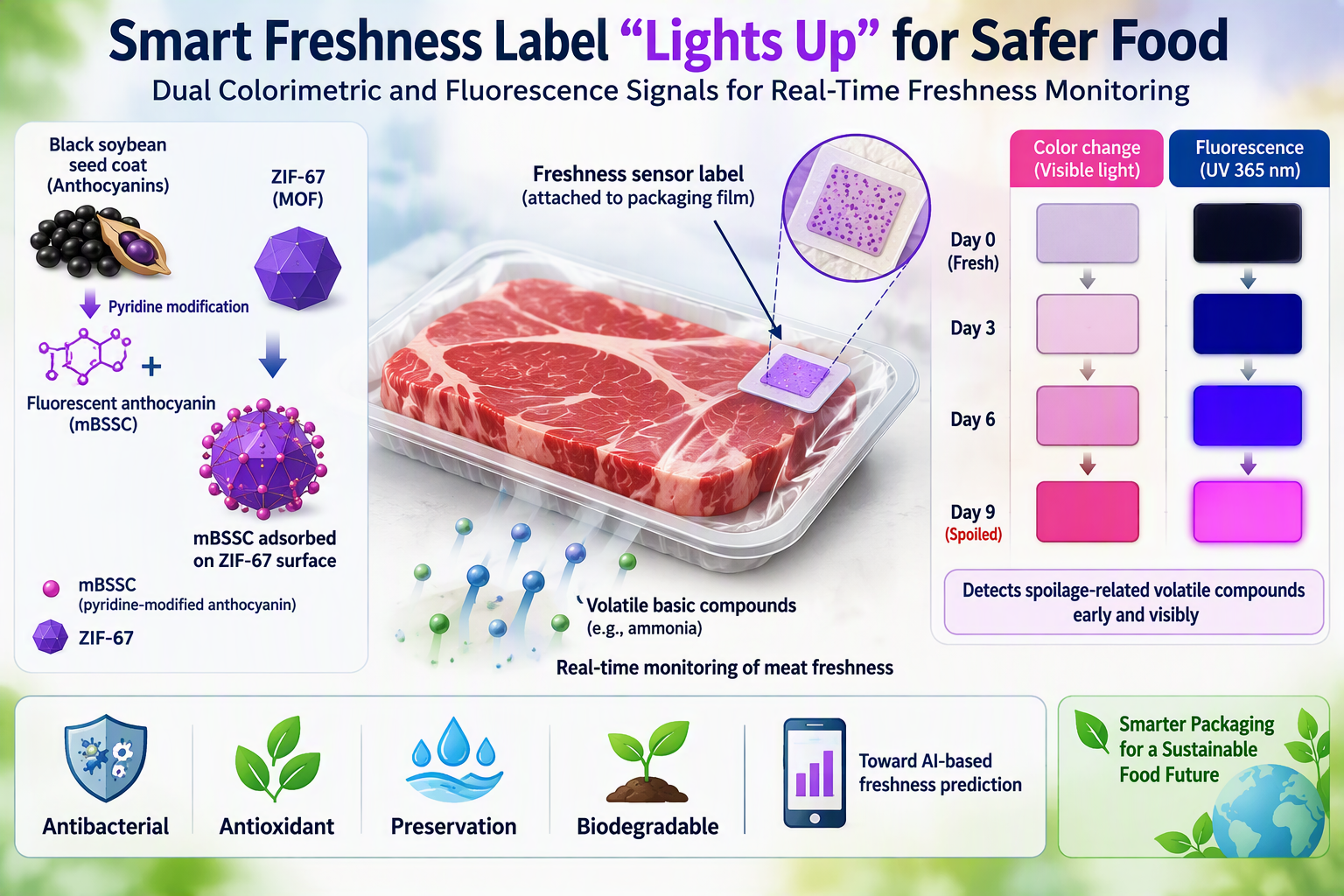
The film features a dual-mode freshness indication system that responds to volatile basic compounds, such as ammonia, generated during food spoilage. Under normal lighting conditions, the film changes color, while under ultraviolet light it emits fluorescence, enabling freshness to be monitored through both visual and fluorescent signals.
In validation tests using refrigerated mutton, both the color and fluorescence of the film changed as spoilage progressed. Notably, the fluorescent mode provided a clear signal from around the sixth day of storage, demonstrating its potential for highly sensitive freshness detection. The film also exhibited antimicrobial and antioxidant properties, contributing to the maintenance of food quality.
Furthermore, the film showed high biodegradability in both soil and seawater, suggesting its potential to reduce environmental impacts associated with packaging waste.
The research findings were published online on August 29, 2026, in the international journal Chemical Engineering Journal.
Figure 1. Conceptual illustration of a smart packaging film for real-time food freshness monitoring through colorimetric and fluorescent signals
Researcher's Comment
Food packaging is no longer expected merely to contain and protect food, but increasingly to provide information about its condition. In this study, we achieved a more reliable freshness-monitoring technology by integrating two types of signals, color and fluorescence. In the future, we expect this technology to be applied to food quality management systems integrated with smartphones and artificial intelligence. (Fumihiko Tanaka)
Glossary
Note 1. Smart packaging
Functional packaging that can detect the condition of food and communicate this information to consumers and stakeholders throughout the food supply chain.
Note 2. Anthocyanins
Naturally occurring pigments found in plants that exhibit color changes in response to variations in pH.
Note 3. ZIF-67
A type of metal-organic framework (MOF) composed of cobalt ions and organic ligands. It possesses antimicrobial properties and a high surface area, making it suitable for applications in sensing and packaging materials.
Publication Information
Journal: Chemical Engineering Journal
Title: A casein-based dual-mode smart film enabled by pyridine-modified anthocyanins and ZIF-67 for real-time mutton freshness monitoring
Authors: Xirui Yan, Fanze Meng, Jiao Zeng, Zhangbin Liu, Anqi Liu, Xinrui Mao, Reshaka Kavindi Malawara Arachchige, Francis Ngwane Nkede, Mohammad Hamayoon Wardak, Amna Bibi, Tran Thi Van, Fumina Tanaka, Fumihiko Tanaka
DOI:10.1016/j.cej.2026.181346
For Research-related inquiries
Fumihiko Tanaka, Professor
Fumina Tanaka, Associate Professor