











 Contact
 Access Map


Research group led by Associate Professor Tsutomu Enoki reveals forest dynamics through data from 191 monitoring sites across Japan
Long-term monitoring data reveal relationship between forest dynamics and climate change
Abstract
Using observational data collected from Japanese forests since the 1950s, the research group analyzed long-term changes in forest structure and the composition of tree functional types across four major forest biomes (Note 1). The results revealed the significant changes in all forest biomes over time. The changes were associated with trends in climate change. The findings suggest that tree species adapted to warmer climates are increasing, while species adapted to colder climates are declining.
These research results were published online in the international scientific journal Forest Ecosystems on August 20, 2026.
Point
- Observational data collected since the 1950s from 191 forest monitoring plots across Japan were compiled, and the annual rate of change in total basal area (TBA; Note 2) was calculated for each plot.
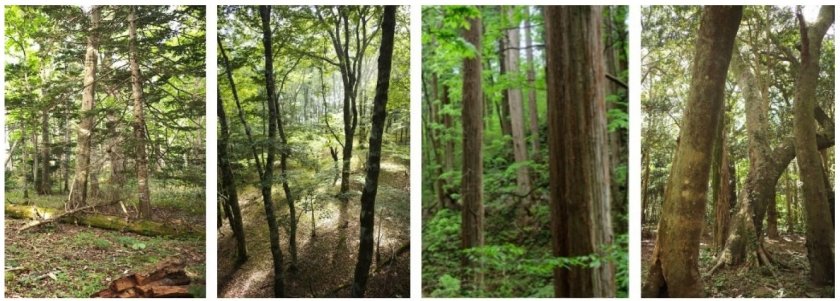
- The monitoring plots were classified into four forest biomes, namely boreal coniferous forest, deciduous broadleaf forest, temperate coniferous forest, and evergreen broadleaf forest (Figure 1). The annual rates of change in TBA and the annual rates of change in the dominance of TBA for each functional type (Note 3) were then calculated for each biome.
- Changes in forest structure and the composition of functional types were observed across all forest biomes, and the structural changes were found to be associated with ongoing climate change trends.
Figure 1. Four major forest biomes found across the Japanese archipelago (Photo: Tsutom Hiura)
Glossary
Note 1. Forest biome
A large-scale ecological classification based on characteristics of the vegetation, including plant life-history traits, physiognomy, and stem density. Forest biomes represent large ecological area characterized by the dominant vegetation and environmental conditions.
Note 2. Total basal area (TBA)
Total basal area (TBA) is the sum of the basal areas of all trees within a monitoring plot. The basal area of an individual tree is calculated from its diameter at breast height (DBH). TBA is widely used as an indicator of forest development, and changes in TBA provide important information for assessing forest growth and decline.
Note 3. Functional type
A functional type is a group of plant species classified based on characteristics such as life-history traits, leaf habit (deciduous or evergreen), and taxonomic affinity. The composition of functional types within a forest varies across different climatic zones and reflects the differences in environmental conditions.
Publication Information
Journal: Forest Ecosystems
Title: Long-term monitoring reveals differential climate and disturbance responses in Japanese forest biome composition
Authors: Tetsuro Yoshikawa, Yayoi Takeuchi, Taku Kadoya, Tsutomu Enoki, Sakae Fujii, Atsuko S. Fukamachi, Mitsuru Hirota, Kazuhiko Hoshizaki, Naoki Iiyama, Yukio Ishikawa, Hiroki Itô, Hajime Kobayashi, Yasuo Konno, Hiroko Kurokawa, Akifumi Makita, Akira S. Mori, Dai Nagamatsu, Tohru Nakashizuka, Kanji Namikawa, Mahoko Noguchi, Michio Oguro, Yoshinobu Ozaki, Michinori Sakimoto, Tamotsu Sato, Hisashi Sugita, Jun-Ichirou Suzuki, Ryo O. Suzuki, Satoshi N. Suzuki, Koichi Takahashi, Ryunosuke Tateno, Ryuichi Watanabe, Hiromi Yamagawa, Tamon Yamashita, Tomohiro Yoshida, Masae I. Ishihara, Tanaka Kenta, Masahiro Nakamura, Tsutom Hiura
URL: https://doi.org/10.1016/j.fecs.2026.100531
- For more details on this research, click here.
For Research-related inquiries