











 Contact
 Access Map


Research group led by Assistant Professor Sadahisa Yagi identifies two species of micro-moths found in bird nests
Their arrival in Japan may be linked to the introduction of their host plants
Points
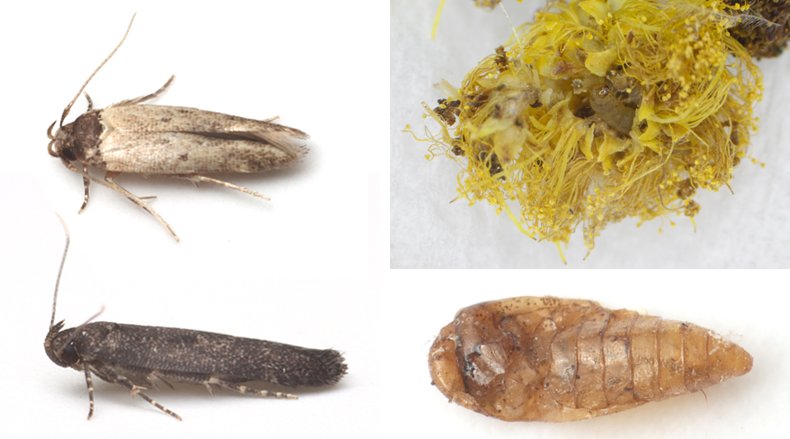
- The research group examined two unidentified species of small moths collected from bird nests and discovered that one was a new species, Gisilia ryukyuensis (Minami-kobukazariba), while the other was Ithome lassula (Ginnemu-kobukazariba), a species recorded in Japan for the first time.
- The researchers also searched for the larvae and confirmed that Gisilia ryukyuensis feeds on the flowers of Acacia confusa, while Ithome lassula feeds on the flowers of Leucaena leucocephala. Both host plants are non-native species that were intentionally introduced to Japan.
- Based on their geographic distribution, associations with host plants, and DNA analyses, the study suggests that these moths may have been introduced to Japan along with their host plants.
Abstract
Several small moths belonging to the subfamily Chrysopeleiinae (Cosmopterigidae) have previously been found emerging from the nests of birds such as shrikes in the Nansei Islands of Japan. However, their exact identities, larval host plants, and the reason they were associated with bird nests had remained unknown.
A research group led by former graduate student Kiyoshiro Goto of the Graduate School of Bioresource and Bioenvironmental Sciences, Kyushu University, and Assistant Professor Sadahisa Yagi of the Faculty of Agriculture, Kyushu University, investigated the identity and ecology of these moths through field surveys in the Ryukyus and Ogasawara Islands, reexamination of specimens collected from bird nests and those preserved in museums and universities, larval rearing, morphological observations, and DNA barcoding analyses.
This study revealed that the moths collected from the nests of birds such as the Lidth's jay represented a previously undescribed species, which was formally described as Gisilia ryukyuensis (Japanese name: Minami-kobukazariba). Another species collected from shrike nests was identified as Ithome lassula, a moth widely distributed in tropical regions. The species was recorded from Japan for the first time and was given the Japanese name Ginnemu-kobukazariba. This study also represents the first record of the genus Ithome in Japan.
The researchers further searched for and reared the larvae of both species. They confirmed that Gisilia ryukyuensis feeds on the flowers of Acacia confusa, while Ithome lassula feeds on the flowers of Leucaena leucocephala, both members of the legume family. Neither plant is native to Japan: A. confusa originates from Taiwan and the Philippines, whereas L. leucocephala is native to Mexico and Central America.
Taken together, these findings suggest that both moth species may heve been introduced into Japan alongside their non-native host plants. The researchers also propose that the moths were collected from bird nests not because their larvae utilize nest materials, but because may larvae or pupae attached to plant materials were inadvertently carried into the nests by birds during nest construction.
The findings were published in the international scientific journal Zootaxa on October 14, 2026
Researcher's Comment
The two moth species identified in this study are commonly found in the Nansei and Ogasawara Islands, yet they have attracted little attention because of their small size and inconspicuous appearance. By investigating their life histories, however, we uncovered clues suggesting that they may have been introduced to Japan together with their host plants and gained new insights into the mystery of why they are found in bird nests.
Even seemingly insignificant small organisms can reveal unexpected discoveries and raise new questions when observed closely. We hope that these tiny moths will inspire people to view the natural world around them from a fresh perspective and appreciate the hidden stories of biodiversity.
(Kiyoshiro Goto)
Publication Information
Journal: Zootaxa
Title: Taxonomic study of flower-feeding moths that emerge from birds' nests, with the description of a new species of Gisilia Kasy, 1968 and first report of Ithome Chambers, 1875 (Lepidoptera, Cosmopterigidae) in Japan
Authors: Kiyoshiro Goto, Yuki Tagawa, Johei Oku, Sadahisa Yagi, Yoshitsugu Nasu & Toshiya Hirowatari
DOI: 10.11646/zootaxa.5890.1.3
- For more details on this research, click here.
For Research-related inquiries