











 Contact
 Access Map


Research group led by Assistant Professor Daiki Takahashi discovers a new plant species on Yakushima Island
DNA analysis reveals look-alike plants are actually different species
Points
- The research group discovered two miniaturized Hypericum plants on Yakushima Island that are remarkably similar in appearance but differ in their evolutionary origins, and described them as a new species, Hypericum yaedakense (Yaedake-otogiri), and a new variety, Hypericum kiusianum var. lucidum (Yakushima-otogiri).
- This study demonstrates that Yakushima Island still harbors undescribed plant species and highlights the importance of uncovering hidden biodiversity through genetic analyses for effective biodiversity conservation.
Abstract
Assistant Professor Daiki Takahashi of the Faculty of Agriculture, Kyushu University, together with Professor Yoshihisa Suyama and Associate Professor Naoko Ishikawa of Tohoku University, Lecturer Masaya Yamamoto of the Graduate School of Education, University of Hyogo, and Tetsukazu Yahara, Director of Research at Kyushu Open University and Professor Emeritus of Kyushu University, has revealed that two Hypericum species occurring on Yakushima Island, a UNESCO World Natural Heritage site, are remarkably similar in appearance, but despite having evolved from different ancestral species. The research team has formally described them as a new species, Hypericum yaedakense, and a new variety, Hypericum kiusianum var. lucidum.
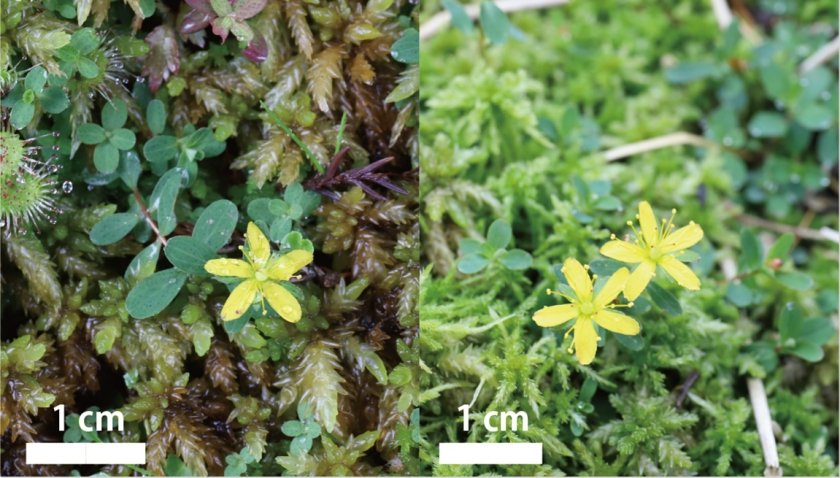
Both plants are small herbaceous species with leaves and petals measuring less than 1 cm in length. In the high-elevation area of Yakushima Island, they grow side by side. Because they can be distinguished only by the gland characteristics of their leaves and sepals, they have long been treated as a single species. However, genetic analyses revealed that the two plants are highly differentiated and have distinct evolutionary origins. Their striking similarity in appearance is therefore considered to be the result of convergent evolution (Note 1), whereby similar traits evolve independently in different evolutionary lineages. Furthermore, the two plants differ in chromosome number. Because their hybrids are unable to produce fertile pollen or egg cells, they can coexist on the small island without losing their species boundaries through gene flow.
This discovery demonstrates that previously undocumented plant taxa can still be found on Yakushima, even along mountain trails that have been surveyed by botanists for decades and are visited by more than 10,000 hikers annually. The findings provide importance of the island's rich biodiversity and highlight how much of its ecosystem remains to be fully understood.
The study was published on June 30, 2026 (Japan Standard Time) in Acta Phytotaxonomica et Geobotanica, a journal specializing in plant taxonomy.
Newly identified Hypericum yaedakense (left) and Hypericum kiusianum var. lucidum (right)
Researcher's Comment
Since it was first described in 1928, only a single species of Hypericum had been recognized from the mountainous regions of Yakushima for nearly a century. In this study, advances in molecular technology enabled us to uncover the existence of a previously overlooked plant species. We hope that these findings will not only highlight the remarkable biodiversity of Yakushima Island, but also encourage greater appreciation of the importance of conserving its unique natural heritage.
― Daiki Takahashi
Glossary
(Note 1) Convergent evolution
Convergent evolution is the process by which organisms from different evolutionary lineages independently evolve similar traits (for example, the wings of birds and bats). The occurrence of such similarities suggests that these traits evolved not by chance, but as a result of strong natural selection acting under similar environmental conditions.
Publication Information
Journal: Acta Phytotaxonomica et Geobotanica
Title: Taxonomic Revision of Hypericum (Hypericaceae) on Yakushima, Japan, with a New Miniaturized Species, H. yaedakense
Authors: Daiki Takahashi, Yoshihisa Suyama, Naoko Ishikawa, Masaya Yamamoto, Tomoko Fukuda, Takuro Ito, Kana Magota, Koji Yonekura, Tetsukazu Yahara.
DOI:10.18942/apg.202517
- For more details on this research, click here.
For Research-related inquiries