











 Contact
 Access Map


Garlic-derived nanoemulsions show promise as eco-friendly fumigants that controls pests of stored beans
Nanoemulsions containing garlic-derived diallyl disulfide effectively control stored-bean pests while promoting seedling growth and preserving beneficial parasitoids
Points
- As demand grows for environmentally sustainable pest control technologies, oil-in-water nanoemulsions(※1) formulated from plant essential oils have attracted considerable attention as novel pest management agents because they readily mix with water and enable the stable release of active ingredients
- Nanoemulsification of diallyl disulfide, the major component of garlic oil, was found to exert strong insecticidal activity against the adzuki bean beetle (Callosobruchus chinensis), a major pest of stored beans, while causing only minimal adverse effects on beneficial insects, and even promoting root development when mixed with spearmint-derived nanoemulsion
- The findings highlight the potential of nanoemulsified diallyl disulfide as a novel environmentally friendly fumigant for postharvest stored grains and legumes
Abstract
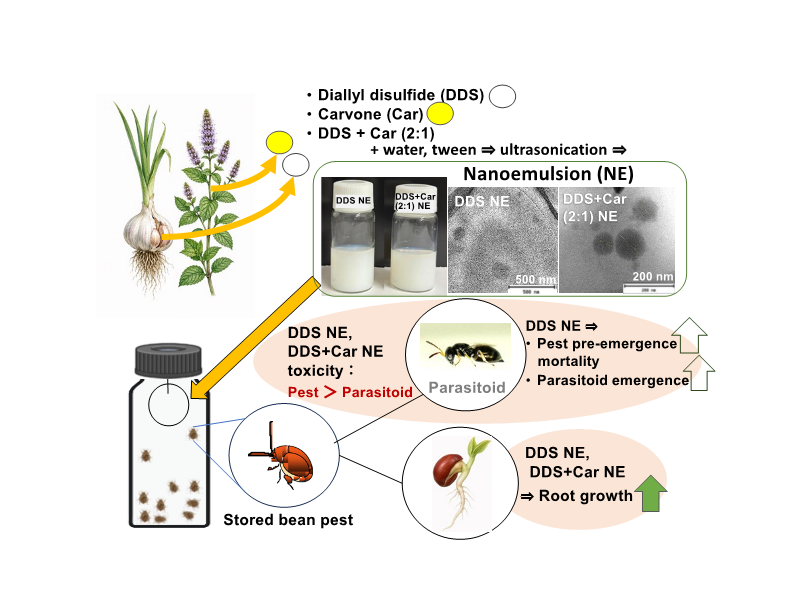
Japan Society for the Promotion of Science (JSPS) Postdoctoral Fellow Dr. Urvashi Sahu and Professor Midori Tuda of the Faculty of Agriculture, Kyushu University, developed oil-in-water nanoemulsions using ultrasonication using diallyl disulfide (DDS), an organosulfur compound derived from garlic essential oil, (R)-carvone (Car), a monoterpenoid derived from spearmint, and their mixtures (1:1 and 2:1). Among the formulations tested, the DDS nanoemulsion exhibited the highest fumigant toxicity against the adzuki bean beetle (Callosobruchus chinensis), a major pest of stored beans. Nanoemulsification enhanced insecticidal activity by 30.5% for DDS and 8.2% for Car. The mixtures displayed additive(※2) toxicity, with their effects corresponding to the combined toxicities of the individual components. Overall, male beetles were more susceptible than females.
Furthermore, at the estimated 24-hour LC₅₀ concentration(※3) for the host pest, the nanoemulsions of DDS and the 2:1 mixture showed relatively low toxicity toward the parasitoid wasp Anisopteromalus calandrae, a natural enemy of stored-product pests, with mortality rates of 22% or less.
Notably, the nanoemulsion of the 2:1 mixture promoted root growth in adzuki bean seedlings, and no residues were detected on the surface of adzuki bean seeds. In addition, when parasitoid wasps were introduced after pest larvae had been exposed to the DDS nanoemulsion, overall pest mortality increased, while the number of emerging parasitoid adults also increased.
These findings demonstrate that nanoemulsions containing DDS, either alone or in a 2:1 mixture with Car, provide strong fumigant activity against stored-product pests while causing minimal adverse effects on parasitoid wasps and stored beans. Moreover, no detectable residues remained on the beans, highlighting the potential of these nanoemulsions as promising pest management agents.
The findings were published online on June 16, 2026 in Ecotoxicology and Environmental Safety.
Researcher's Comment
When people hear the word "pesticide," they often think of synthetic chemicals. However, plants naturally produce many compounds that defend them against insect attack. In this study, we used nanotechnology to improve the stability and delivery of such naturally occurring compounds from garlic and spearmint. Our results suggest that these nanoemulsions can effectively control stored-product pests while having limited effects on beneficial insects, making them promising candidates for environmentally friendly pest management.
(Urvashi Sahu)
Glossary
(※1) Oil-in-water nanoemulsion
A formulation in which oil-based compounds are dispersed in water as nanoscale droplets. By reducing active ingredients to the nanoscale, nanoemulsions can improve their stability and potentially reduce the amount required to achieve effective biological activity.
(※2) Additive
A relationship between two compounds in which neither enhances nor reduces the effect of the other when applied together. In an additive interaction, the combined effect is equal to the sum of the effects produced by each compound individually.
(※3) LC₅₀ concentration
The median lethal concentration (LC₅₀), defined as the concentration of a substance predicted to cause mortality in 50% of a test population within a specified exposure period. It is widely used as an indicator of acute toxicity.
Publication Information
Journal: Ecotoxicology and Environmental Safety
Title: Enhanced toxicity of diallyl disulfide and carvone nanoemulsions against a stored bean pest and their nontarget effects on its parasitoid and seed viability
Authors: Sahu U., Helmy E. A. M., Tuda M.
DOI: 10.1016/j.ecoenv.2026.120374
- For more details on this research, click here.
For Research-related inquiries