











 Contact
 Access Map


Diversity of Japanese Homoeusa: Beetles that Live with Ants Revealed
Advancing the Evolutionary Study of Symbiosis in Myrmecophilous Insects
Key Points
- A taxonomic study of more than 2,000 specimens of the rove beetle genus Homoeusa-a group known for living inside ant colonies-collected from across Japan revealed that nine species occur in Japan, including three newly described species. (Photo: left)
- For the first time in the genus, a species utilizing the Lasius umbratus species group as host ants was formally recorded and described as new to science.
- Behavioral observations demonstrated that the degree of "intimacy" with host ants varies widely among species.
- Building upon the detailed taxonomic and ecological information obtained, the research team has begun DNA-based analyses to investigate how symbiotic relationships with host ants (photo: right) have evolved. These studies are expected to contribute not only to the understanding of myrmecophilous insects but also to general principles in evolutionary biology.
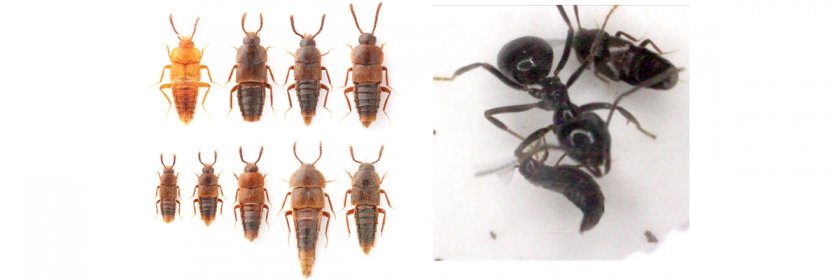
Ant nests harbor a diverse array of organisms such as ant crickets and lycaenid butterfly larvae, forming complex symbiotic systems collectively known as "myrmecophily" (※1). Among insects, rove beetles (Staphylinidae) are particularly rich in myrmecophilous species. The genus Homoeusa represents one such group, living specifically within colonies of the ant genus Lasius.
Despite their evolutionary importance, research on this group had long lagged behind, mainly because the beetles are extremely small (2-3 mm) and morphologically similar, making species identification difficult.
A research team led by Tsubasa Nozaki, a third-year PhD student in the Graduate School of Bioresource and Bioenvironmental Sciences at Kyushu University, and Associate Professor Munetoshi Maruyama of the Kyushu University Museum (also affiliated with the same graduate school), conducted a detailed examination of over 2,000 specimens. These included material collected nationwide by the authors and numerous enthusiasts, housed in the Kyushu University Museum, supplemented by specimens from domestic and international institutions.
Their study revealed that nine species of Homoeusa occur in Japan, three of which are new to science. Notably, they formally documented and described the first species in the genus known to utilize the Lasius umbratus group as host ants.
Behavioral observations made both in the field and laboratory further showed substantial interspecific variation in how the beetles interact with their host ants.
Building on these findings, the team has initiated molecular research to reconstruct the evolutionary history of host associations-examining how relationships with specific ant species have diversified over long evolutionary timescales. These efforts are expected to influence the broader study of evolutionary patterns in other organisms.
The Kyushu University Museum houses the largest collection of myrmecophilous insects in Asia, including many undescribed species. The collection will continue to serve as a foundation for research and education.
This research was published on December 3, 2025, in the German journal Deutsche Entomologische Zeitschrift.
Glossary
(※1) Myrmecophily
A lifestyle that involves utilizing ant colonies. In the narrower sense, it refers to organisms whose life cycles cannot be completed without ants. Rove beetles contain a huge number of myrmecophilous species compared with other insect groups.
Publication Information
Journal: Deutsche Entomologische Zeitschrift
Title: Taxonomy of Homoeusa Kraatz, 1856 (Coleoptera, Staphylinidae,Aleocharinae) from the East Palearctic: II. Revision of Japanese species
Title: Taxonomy of Homoeusa Kraatz, 1856 (Coleoptera, Staphylinidae, Aleocharinae) from the East Palearctic: II. Revision of Japanese species
Japanese title: 旧北区におけるヒラタアリヤドリ属の分類学II.日本産種の分類学的再検討】
Authors: Tsubasa Nozaki & Munetoshi Maruyama
DOI:10.3897/dez.72.158689
- More details available here
Contact
Associate Professor Munetoshi Maruyama
Kyushu University Museum