











 Contact
 Access Map


A research group led by Professor Yushi Ishibashi has revealed the environmental memory acquired by seeds to survive environmental changes!
Toward developing novel food production technologies under global environmental change by harnessing "seed memory"
Points
- The subsequent growth of seeds produced under environmental change had remained unclear.
- The study elucidated the mechanism by which the grain-filling environment*1 is memorized in seeds and demonstrated its contribution to environmental stress tolerance and yield improvement.
- The use of environmentally primed seeds is expected to enable new approaches to food production.
Abstract
In recent years, rising global temperatures have led to frequent high-temperature events during the grain-filling period, posing serious challenges to rice yield and quality. This phenomenon has been identified as one of the factors behind the so-called "Reiwa rice crisis." Meanwhile, it has remained unclear whether environmental conditions during grain filling affect the growth and agronomic traits of the next generation, and, if so, what molecular mechanisms underlie these effects. In particular, linking the transmission of environmental information to the next generation with field-level traits has become a critical issue for practical food production.
This study demonstrated a novel mechanism in which high temperatures during the grain-filling period in rice induce "epigenetic" memory in seeds via DNA methylation*2, and this memory subsequently alters gene expression and agronomic traits, including yield, in the next generation.
A research group led by Assistant Professor Suriyasak Chetphilin and Professor Yushi Ishibashi at the Faculty of Agriculture, Kyushu University, cultivated rice seeds matured under optimal and high-temperature conditions during the grain-filling period, and investigated DNA methylation states in the seeds as well as gene expression and agronomic traits in the subsequent generation grown from these seeds.
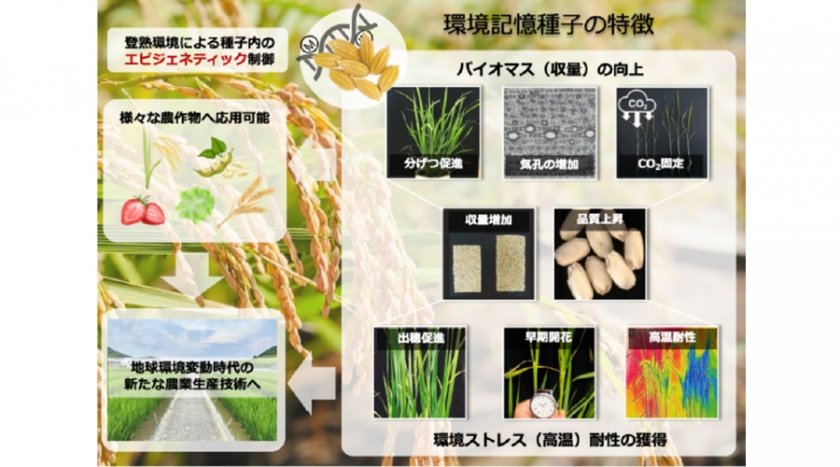
As a result, numerous differentially methylated regions were detected in seeds matured under high-temperature conditions, and many genes showed altered expression in the subsequent generation. Furthermore, the progeny exhibited phenotypic changes, including an increased number of tillers, higher stomatal density, earlier heading, and early-morning flowering, indicating enhanced tolerance to high-temperature stress. Field trials further confirmed that the progeny derived from high-temperature-matured seeds exhibited approximately 10% higher yield. In addition, for candidate genes associated with these traits, changes in DNA methylation in promoter regions*4 were consistent with changes in gene expression, and the DNA methylation established in seeds was also found to be maintained in the organs of the subsequent generation.
This study presents a new direction for addressing increasing high-temperature stress under climate change by harnessing "epigenomic memory" in seeds to favorably regulate agronomic traits in subsequent generations. These findings suggest that traits may be modulated through environmental design during seed development without altering DNA sequences. In the future, this approach is expected to contribute to the development of climate-resilient cultivation strategies, optimization of seed production and seedling management processes, and technologies for stabilizing crop yield.
The results of this study were published online on April 22, 2026, in the international academic journal Plant Physiology.
Researcher's Comment
Food production instability caused by global environmental change has become a shared global challenge, and the establishment of technologies for stable food production is urgently required. The environmentally controlled epigenomic seeds identified in this study can be regarded as one of the strategies by which plants adapt to their environments. Notably, because this approach can maximize the inherent potential of existing crops without genetic modification, it may be applicable to a wide range of crops. We aim to address global food production challenges through "epigenomic seeds" originating from Japan. (Yushi Ishibashi)
Glossary
*1 Grain-Filling Environment
Refers to the environmental conditions during the period after flowering and pollination when grains grow and develop. In recent years, high-temperature conditions during grain filling caused by global warming have been shown to markedly reduce grain quality and yield in rice.
*2 DNA Methylation
Refers to the addition of a methyl group (-CH₃) to the cytosine (C) base in DNA. In plants, this modification predominantly occurs in CG, CHG, and CHH contexts (H = A, T, or C) and plays a key role in the regulation of gene expression. In general, increased or decreased methylation near promoter regions regulates gene expression through effects on transcription factor binding and chromatin state. Under environmental stress and other conditions, methylation patterns can be reprogrammed and maintained over a certain period, in some cases functioning as a form of "memory."
*3 Epigenetics
Refers to phenomena that regulate gene activity without changes to the DNA base sequence, thereby influencing cellular and tissue states as well as phenotypes. Major underlying mechanisms include DNA methylation, histone modification, chromatin remodeling, and transcriptional and post-transcriptional regulation mediated by small RNAs (e.g., siRNAs).
*4 Promoter Region
Refers to the region located around the transcription start site (TSS) that determines the recruitment of RNA polymerase II and the frequency of transcription initiation. It generally encompasses a defined upstream range from the TSS (e.g., several hundred base pairs to several kilobases) and includes transcription factor binding sites and core promoter elements, thereby playing a central role in the regulation of gene expression.
Publication Information
Journal: Plant Physiology
Title: Grain maturing temperature induces seed epi-memory via DNA methylation for subsequent development in rice.
Authors: Chetphilin Suriyasak, Yui Oyama, Ryusuke Kawaguchi, Ryo Matsumoto, Yuta Sawada, Wun-Jin Chen, Hue Thi Nang, Norimitsu Hamaoka, Yushi Ishibashi
DOI:10.1093/plphys/kiag219
- For more details on this research, click here.
For Research-related inquiries