











 Contact
 Access Map


A research group led by Professor Akiko Maruyama-Nakashita has developed a novel root-specific gene expression system that enhances anthocyanin accumulation and plant growth
SULTR2;1 3' downstream region-driven PAP1 boosts anthocyanin and plant growth
Points
- High-level expression systems in plants often modify the native gene's upstream region, which can lead to the loss of natural expression characteristics.
- The research team constructed a novel gene expression system utilizing the 3' downstream region*1 of the sulfate transporter SULTR2;1*2 gene to drive the expression of PAP1*3, an anthocyanin*4 biosynthesis regulator.
- Transgenic Arabidopsis plants showed visibly purple roots due to anthocyanin accumulation, increased plant growth, and higher tolerance to salt stress owing to enhanced antioxidant activity.
Abstract
High-level expression systems in plants are essential for basic research and the enhancement of desired agricultural traits. However, most conventional systems modify the 5' upstream region of the native gene, which can result in the loss of its natural spatiotemporal expression characteristics.
A research group led by Professor Akiko Maruyama-Nakashita has developed a novel expression system targeting plant roots. Building on previous findings that the 3' downstream region of the sulfate transporter SULTR2;1 gene (TSULTR2;1) increases gene expression under sulfur deficiency (−S), the team selected PAP1―a positive regulator of anthocyanin biosynthesis―to test this downstream region-driven system in the model plant Arabidopsis thaliana.
The results revealed that under sulfur-deficient conditions, the transgenic roots exhibited significantly higher PAP1 gene expression compared to wild-type plants. This visibly changed the root color to pink-purple due to the accumulation of anthocyanin. Furthermore, these transgenic plants demonstrated increased overall plant growth, including higher fresh weights and greater seed yields, regardless of sulfur conditions. Due to the increased antioxidant activity from anthocyanin accumulation, the plants also exhibited a higher tolerance to salt stress.
These findings highlight the potential of TSULTR2;1 as a highly effective target for gene expression technology in plant roots. The method provides a new avenue for safely enhancing nutrient quality, overall growth, stress tolerance, and the color of commercial root vegetable crops in the future.
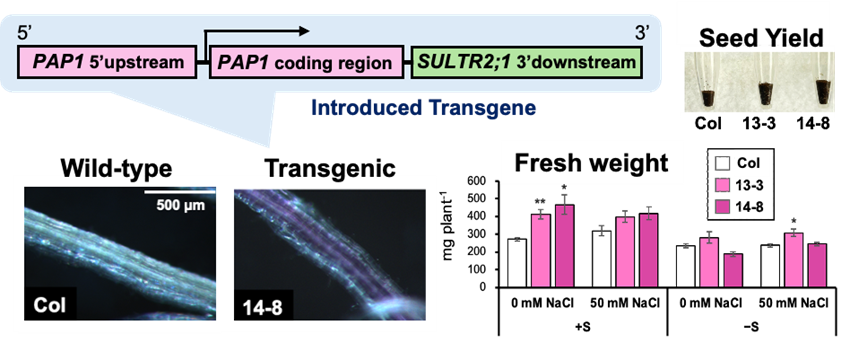
Figure 1. Plants expressing the PAP1 gene combined with the SULTR2;1 3' downstream region
Upper left: Introduced transgene
Lower left: Anthocyanin accumulates in the roots of transgenic plants (line 14-8) grown under sulfur-deficient conditions. Col represents the wild-type strain.
Upper right: Seed yield of plants grown under sulfur-deficient and 50 mM NaCl conditions. Lines 13-3 and 14-8 are transgenic plants.
Lower right: Fresh weight of the plants.
Researcher's Comment
This study demonstrates that TSULTR2;1 is useful as a promising gene expression technology for genes functioning in the roots. By successfully applying this system to increase anthocyanin content, we observed enhanced plant growth and salt stress tolerance. It is also applicable to other genes desired to be expressed in roots. We believe this method can effectively enhance the nutrient quality, stress tolerance, and color of commercial root vegetable crops, contributing to the improvement of agricultural traits. (Akiko Maruyama-Nakashita)
Glossary
(*1 3' downstream region
A sequence located after (downstream of) the coding region of a gene. The 3' downstream region of the SULTR2;1 gene contains specific regulatory elements that increase gene expression in roots in response to sulfur deficiency.
*2 SULTR2;1
A low-affinity sulfate transporter expressed in xylem parenchyma and pericycle cells of plant roots, which promotes the transport of sulfate from the roots to the shoots.
*3 PAP1
Production of Anthocyanin Pigment 1 (also known as MYB75), a transcription factor that acts as a positive regulator to activate the transcription of late anthocyanin biosynthetic
*4 Anthocyanins
Members of the flavonoid family that induce red, purple, or blue pigments in higher plants. They function as antioxidants and improve plants' tolerance to various abiotic and biotic stresses, such as high salinity and oxidative stress.
Publication Information
Journal: Plant Molecular Biology
Title: Increased anthocyanin accumulation and plant growth by driving PAP1 expression using the 3′downstream region of the sulfate transporter SULTR2;1 gene
Authors: Nguyen Ha Trang, Abdul wakilu Sulemana, Moeka Fujita, Li Hongqiao, Chihiro Ohtaki, Akiko Suyama, Akiko Maruyama-Nakashita
DOI: 10.1007/s11103-025-01676-5
For Research-related inquiries