











 Contact
 Access Map


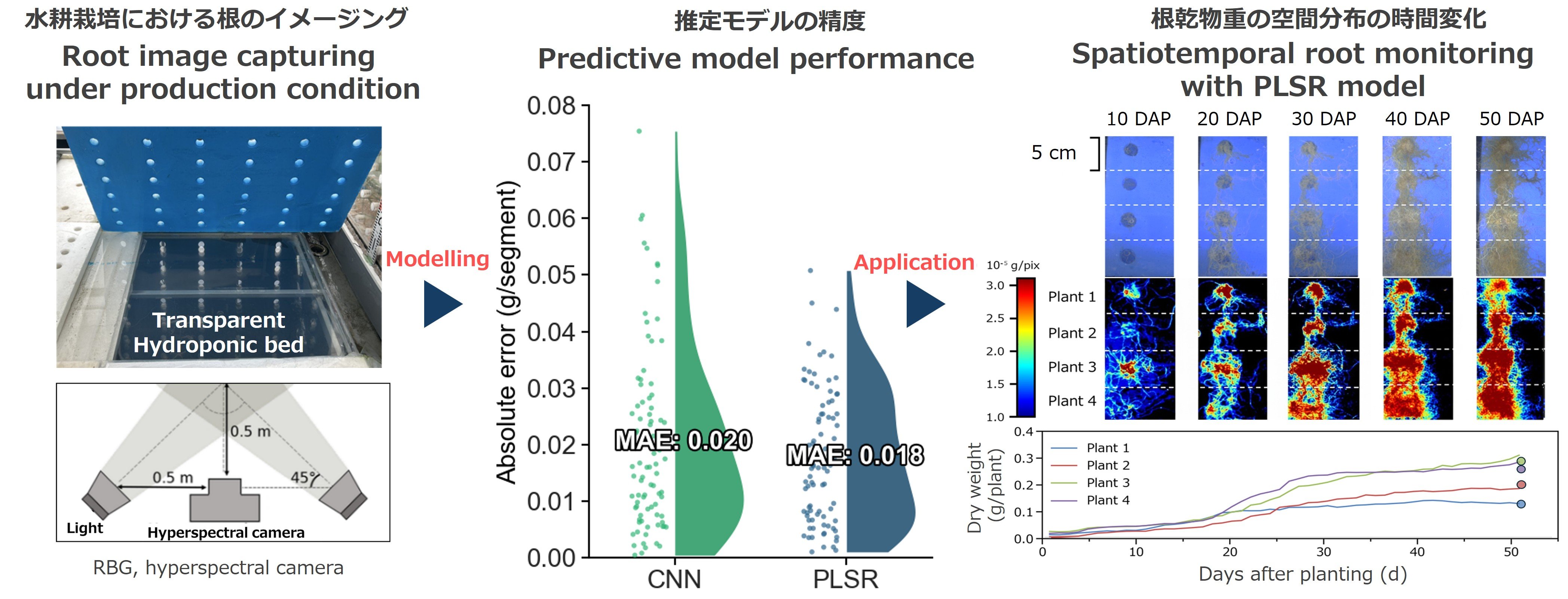
A research group led by Associate Professor Daisuke Yasutake has developed the world's first technology to continuously monitor root growth non-destructively in hydroponic crop production
Advancing smart agriculture through precise root growth monitoring and control
Points
- First monitoring technology for vegetable roots under actual cultivation conditions, not in laboratory settings
- Visualizes spatial distribution of root biomass across the entire root system using hyperspectral imaging*1 and machine learning*2
- Tracks temporal dynamics of root growth (dry weight) throughout extended cultivation periods
Abstract
For the realization of data-driven precision agriculture and smart agriculture, it is necessary to understand crop growth status. While monitoring technologies exist for visible parts such as leaves, stems, and fruits, technologies targeting roots have remained at the laboratory level.
A research group consisting of Mr. Jin Ziyi (Doctoral Program in Bioresource and Bioenvironmental Sciences, Kyushu University), Associate Professor Daisuke Yasutake (Faculty of Agriculture, Kyushu University), and researchers from Kochi University's IoP Co-Creation Center and Yamaguchi University's Graduate School of Sciences and Technology for Innovation has developed a technology to observe the entire root system by making part of a hydroponic cultivation system transparent and estimate root dry weight from hyperspectral reflectance images*1 combined with machine learning*2 prediction models. This technology enabled high-precision monitoring of root growth in leafy vegetables (spinach) under actual production conditions, from transplanting to harvest.
This technology will enable smart agriculture systems that precisely monitor and manage not only above-ground organs (leaves, stems, fruits) but also root growth.
These findings were published online in the journal Plant Methods (Springer Nature) on March 10, 2026.
Message from the Researchers
Plant roots are often called the "hidden half" because they grow underground and are difficult to observe. Consequently, most root monitoring research has been confined to laboratory settings, far removed from actual production conditions. While our study focuses on hydroponic cultivation, I believe this represents groundbreaking work in demonstrating continuous, non-destructive root monitoring under real production conditions for the first time. This achievement will pave the way for precision root management in next-generation smart agriculture.
(Daisuke Yasutake)
The application of spectral imaging technology to root systems has long been hindered by the inherent concealment of roots. This study not only enables continuous monitoring of root development throughout the growth period but also captures crucial spectral data that was previously difficult to obtain. We believe these findings will provide novel insights into future root phenotyping.
(Ziyi Jin)
Glossary
*1 Spectral imaging
Images that record light reflected from objects separated into multiple wavelength bands. While conventional color photographs only contain information from three colors (red, green, and blue), spectral images contain information from hundreds of wavelength bands, enabling identification of object properties that are invisible to the human eye.
*2 Machine learning
A technology that enables computers to automatically learn patterns and regularities from large amounts of data and make predictions or judgments.
Publication Information
Journal: Plant Methods
Title: Non-destructive monitoring of root biomass in hydroponically grown leafy vegetables: comparison between machine learning-based RGB and hyperspectral imaging
Authors: Ziyi Jin, Daisuke Yasutake, Tadashige Iwao, Yuki Sago, Gaku Yokoyama, Shigehiro Kubota, Tomoyoshi Hirota
DOI:10.1186/s13007-026-01515-8
For Research-related inquiries