











 Contact
 Access Map


Research group led by Associate Professor Keisuke Ikegami has uncovered why intraocular pressure rises at night in both humans and mice
Additive framework of hormonal waves produce circadian rhythms of intraocular pressure associated with glaucoma risk
Points
- Addressing the mystery of why intraocular pressure rises at night in both humans and mice despite their opposite activity patterns
- Developed a simple mathematical model integrating diurnal rhythms in two hormones
- Explains age-related changes in intraocular pressure rhythms as well as differences between species
- Potential applications in chronotherapy and personalized medicine for glaucoma
Abstract
Intraocular pressure (IOP) is the primary risk factor for glaucoma (Note 1) and is known to change significantly over the course of the day. However, although humans are active during the day and mice are active at night, both species exhibit elevated IOP during the nighttime. The mechanism underlying this paradox has remained unclear for many years. Additionally, age-related changes in IOP rhythms have been reported, yet no unified theory has been available to explain both the differences between species and the effects of aging on these rhythms.
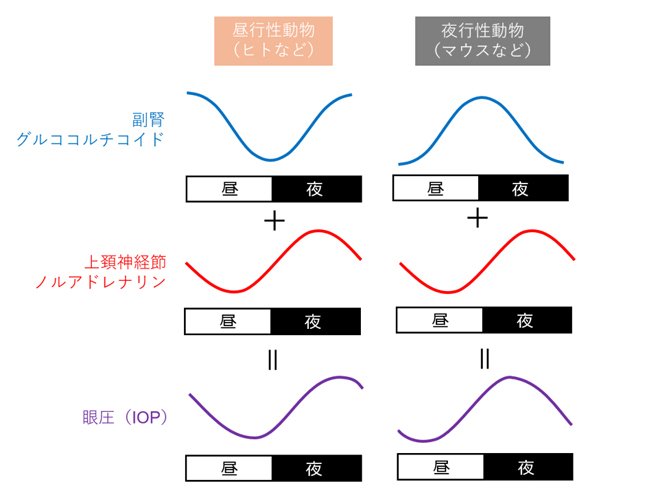
A research group led by Associate Professor Keisuke Ikegami from the Faculty of Agriculture at Kyushu University has proposed a new mathematical model demonstrating that diurnal rhythms (Note 2) in IOP arise from the combined effects of two biological signals: glucocorticoids (Note 3) secreted by the adrenal glands and noradrenaline (Note 4) released by the sympathetic nervous system.
The researchers focused on the roles of glucocorticoids and sympathetic nerve activity in regulating IOP rhythms, which they had previously investigated. They analyzed published datasets from humans and experimental animals, measured IOP in young and aged mice, and conducted sympathetic denervation experiments. Their findings revealed that the temporal overlap of the "waves" generated by these two signals can provide a unified explanation for both the differences in IOP rhythms between humans and mice and the age-related changes observed in these rhythms (Figure 1).
These findings offer a new theoretical framework for understanding diurnal rhythms in IOP. In the future, this framework may aid in developing diagnostic approaches for predicting IOP fluctuations in individual patients, as well as chronotherapy strategies that optimize the timing of drug administration.
The results of this study were published in the international scientific journal npj Biological Timing and Sleep, published by Springer Nature, on July 6, 2026 (18:00 JST).
Figure 1. Intraocular pressure fluctuations generated by the sum of the "waves" of two factors
Researcher's Comment
We have previously demonstrated that both glucocorticoids and the sympathetic nervous system contribute to the daily regulation of intraocular pressure. In this study, we integrated these findings into a single framework, showing that it can explain both the differences between humans and mice and the changes associated with aging. We hope to further advance research on intraocular pressure rhythms and contribute to the development of new diagnostic and therapeutic approaches for glaucoma.
(Keisuke Ikegami)
Glossary
Note 1. Glaucoma
A disease characterized by progressive damage to the optic nerve, leading to gradual loss of vision. Glaucoma is one of the leading causes of blindness worldwide, and elevated intraocular pressure is recognized as its most significant risk factor.
Note 2. Diurnal rhythms
Physiological functions such as body temperature, blood pressure, and hormone secretion undergo regular changes over the course of a day. These approximately 24-hour cycles are referred to as daily fluctuations. Diurnal rhythms are regulated by the biological clock and are considered a fundamental mechanism that enables organisms to adapt to changes in the day-night environment.
Note 3. Glucocorticoids
Glucocorticoids are a class of hormones secreted by the adrenal glands. Representative examples include cortisol in humans and corticosterone in mice. In addition to playing essential roles in stress responses and metabolic regulation, glucocorticoids act as systemic signals that convey circadian timing information from the biological clock to tissues throughout the body. In this study, glucocorticoids were investigated as one of the factors contributing to the generation of diurnal rhythms in intraocular pressure.
Note 4. Norepinephrine
Noradrenaline is a neurotransmitter released by the sympathetic nervous system, involved in regulating blood pressure, heart rate, and the maintenance of wakefulness. In this study, the researchers demonstrated that noradrenaline released from sympathetic nerves innervating the eye functions as an important signal regulating the diurnal rhythms of intraocular pressure.
Publication Information
Journal: npj Biological Timing and Sleep
Title: Additive framework of hormonal waves accounts for species and age differences in circadian intraocular pressure rhythm
Authors: Keisuke Ikegami, Ryo Fujie, Fumito Mori, Shinobu Yasuo
DOI:10.1038/s44323-026-00096-y
- For more details on this research, click here.
For Research-related inquiries