











 Contact
 Access Map


Structural basis of plant organelle C-to-U RNA editing by PPR-DYW proteins
Crystal structures reveal how the PPR domain and DYW deaminase domain coordinate to achieve precise C-to-U RNA editing.
A research group led by Assistant Professor Takamasa Teramoto and Professor Yoshimitsu Kakuta at the Laboratory of Biophysical Chemistry, Faculty of Agriculture, Kyushu University, has clarified how PPR-DYW proteins recognize target RNA and catalyze precise C-to-U editing in plant organelles.
Highlights
- Plant chloroplasts and mitochondria use PPR-DYW proteins to convert specific cytidines (C) to uridines (U) in RNA, a process essential for functional protein expression in plant organelles.
- The group determined crystal structures of a consensus PPR-DYW (consPPR-DYW) protein in both RNA-free and target RNA-bound states.
- The structures show that the PPR domain accommodates the upstream sequence of the target C base, while the DYW domain is optimally positioned for precise C-to-U conversion.
- These findings provide a mechanistic model for the coordinated action of the PPR and DYW domains and a structural framework for developing new RNA editing tools.
Overview
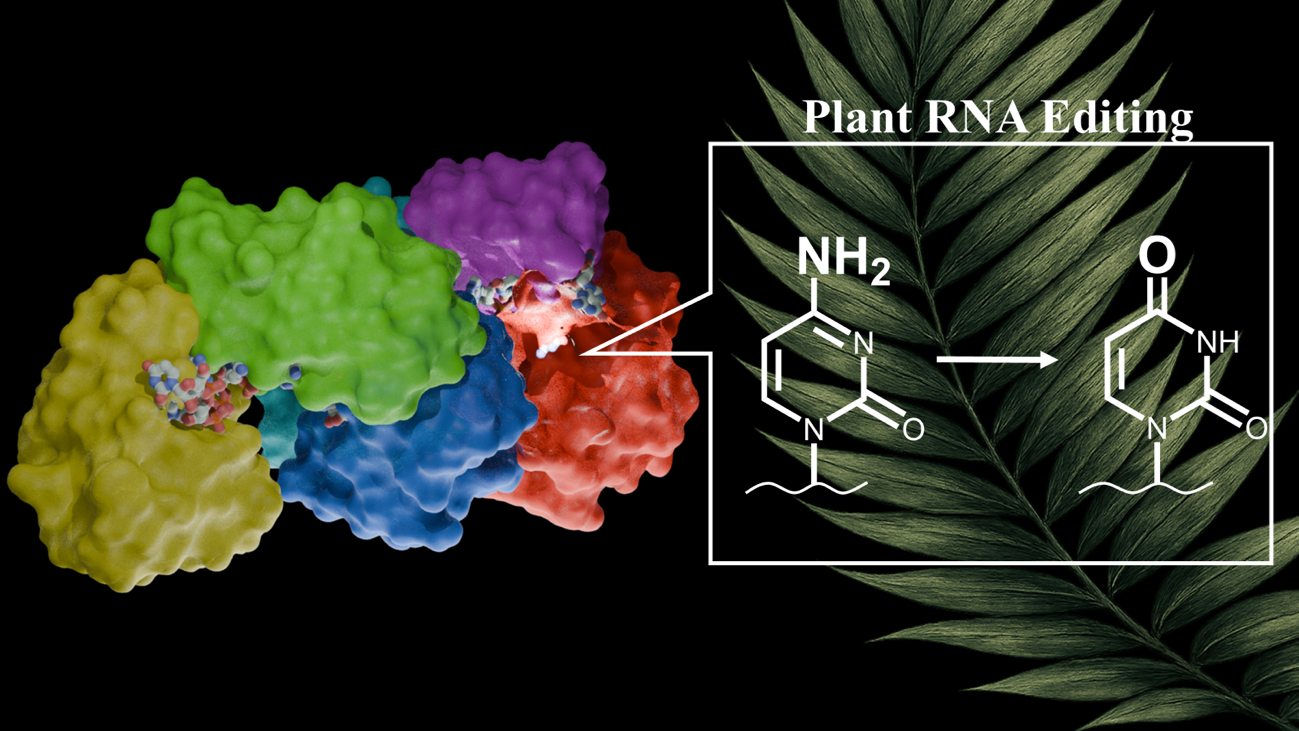
RNA base editing is a post-transcriptional modification process that rewrites genetic information within transcribed RNAs. Plants have evolved a unique C-to-U RNA editing mechanism mediated by PPR-DYW proteins. In this mechanism, the PPR domain recognizes specific RNA sequences, and the DYW deaminase domain precisely edits the target C base.
The research group, in collaboration with Professor Takahiro Nakamura at Kyushu University and researchers at EditForce, Inc., designed and analyzed a consensus PPR-DYW protein (consPPR-DYW), a representative of PPR-DYW proteins. Using X-ray crystallography at SPring-8 and biochemical analyses, the group determined the three-dimensional arrangement of the PPR and DYW domains in RNA-free and target RNA-bound states.
Comparison of the two states showed domain movements upon target RNA binding. The PPR domain accommodates the upstream sequence of the target C base in the proper conformation for editing, and the E1-E2 motifs and DYW domain form an accommodation tunnel that places the target C base at the zinc-dependent catalytic center of the DYW domain.
These results explain how the coordinated action of the PPR and DYW domains enables precise C-to-U editing. The study advances the fundamental understanding of plant organellar RNA editing machinery and establishes the structural framework necessary for developing new RNA editing tools.
Figure
Key terms
PPR-DYW proteins: Plant-specific RNA editing enzymes composed of an RNA-recognizing PPR domain and a C-to-U catalytic DYW deaminase domain.
PPR domain: Pentatricopeptide repeat domain that recognizes RNA sequences in a modular manner.
DYW domain: A deaminase domain named after the conserved Aspartate-Tyrosine-Tryptophan (D-Y-W) tripeptide. It contains a zinc-dependent catalytic center.
C-to-U RNA editing: Conversion of cytidine (C) to uridine (U) in RNA after transcription.
Consensus PPR-DYW protein: An engineered protein designed from conserved sequence features and used as a representative model of PPR-DYW proteins.
RNA editing tools: Technologies that rewrite RNA bases at target sites without permanently changing genomic DNA.
Paper information
Journal: Nature Communications Title: Structural basis of plant organelle C-to-U RNA editing by PPR-DYW proteins
Authors: Takamasa Teramoto*, Ryota Urushihara, Reiya Aoyama, Ayumi Okada, Mizuho Ichinose, Yusuke Yagi, Takahiro Nakamura, Bernard Gutmann, Yoshimitsu Kakuta* *Corresponding authors: Takamasa Teramoto and Yoshimitsu Kakuta
DOI: 10.1038/s41467-026-72391-y
Publication: Nature Communications, 2026
Contact
Takamasa Teramoto, Assistant Professor: Laboratory of Biophysical Chemistry, Department of Bioscience and Biotechnology, Faculty of Agriculture, Kyushu University
Yoshimitsu Kakuta, Professor: Laboratory of Biophysical Chemistry, Department of Bioscience and Biotechnology, Faculty of Agriculture, Kyushu University