











 Contact
 Access Map


Researchers reveal how tyrosine sulfation regulates CCR5, a human cell-surface receptor involved in immune responses and HIV infection
Structural basis of a post-translational modification that controls cell-surface receptor function
Research group: Professor Yoshimitsu Kakuta, Associate Professor Etsuko Nishimoto, Assistant Professor Takamasa Teramoto and colleagues, Division of Applied Life Chemistry, Laboratory of Biophysical Chemistry, Faculty of Agriculture, Kyushu University
Key points
- CCR5, a human cell-surface chemokine receptor involved in immune responses and HIV infection, is regulated by sulfation of specific N-terminal tyrosine residues by human tyrosylprotein sulfotransferases (hTPSTs). However, the molecular mechanism by which these tyrosine residues are recognized had remained unclear.
- The research group determined the crystal structure of hTPST1 in complex with a CCR5-derived peptide and PAP, the sulfate donor product, revealing a Y3-centered recognition mode relevant to tyrosine sulfation in the Golgi lumen.
- The findings provide a structural framework for understanding chemokine receptor sulfation and may contribute to future strategies for modulating viral infection, immune responses and inflammatory processes.
Summary
A research group led by Professor Yoshimitsu Kakuta, Associate Professor Etsuko Nishimoto and Assistant Professor Takamasa Teramoto of the Faculty of Agriculture, Kyushu University, together with graduate students Shinnosuke Tanaka, Kota Toyoda and Hirai Asano (at the time), has clarified the molecular mechanism by which C-C chemokine receptor type 5 (CCR5), a human cell-surface receptor, is modified by tyrosine sulfation catalyzed by human tyrosylprotein sulfotransferases (hTPSTs). This study was conducted in collaboration with the University of Miyazaki.
CCR5 is a chemokine receptor that contributes to immune-cell trafficking and inflammatory responses. It is also known as an important coreceptor used by HIV to enter host cells. The flexible N-terminal extracellular domain of CCR5 contains multiple tyrosine residues, including Y3, Y10, Y14 and Y15. Sulfation of these residues modulates interactions with chemokines and viral proteins. However, the detailed molecular basis for how hTPSTs recognize the individual tyrosine residues of CCR5 had not been fully resolved.
In this study, the researchers determined the X-ray crystal structure of the soluble domain of hTPST1 bound to PAP (3'-phosphoadenosine 5'-phosphate) and a modified 18-residue CCR5 peptide designed to isolate the Y3-centered binding mode. The structure showed that the N-terminal residues of the CCR5 peptide, particularly M1, D2 and Y3, make major contributions to binding and place the acceptor tyrosine residue in a position suitable for sulfation. Based on this crystal structure, the group also constructed peptide docking models for Y10, Y14 and Y15 sulfation, as well as full-length hTPST1-PAP-CCR5 docking models.
These analyses suggest that the hTPST1 substrate-binding pocket can accommodate multiple local sequence contexts in the CCR5 N-terminal region through a combination of hydrophobic and electrostatic interactions. The crystal structure provides experimental insight into Y3 recognition, whereas the docking models provide testable hypotheses for how the other sulfation sites may be accommodated in the context of CCR5.
This work provides an important structural framework for understanding how CCR5 tyrosine sulfation occurs at the atomic level. In the future, the findings are expected to contribute to studies of sulfation-mediated regulation of chemokine receptors and to a deeper understanding of molecular recognition processes involved in viral infection, immune responses and inflammation.
The study was published in The FEBS Journal, a journal published by John Wiley & Sons Ltd on behalf of the Federation of European Biochemical Societies, on 22 May 2026.
Figure1
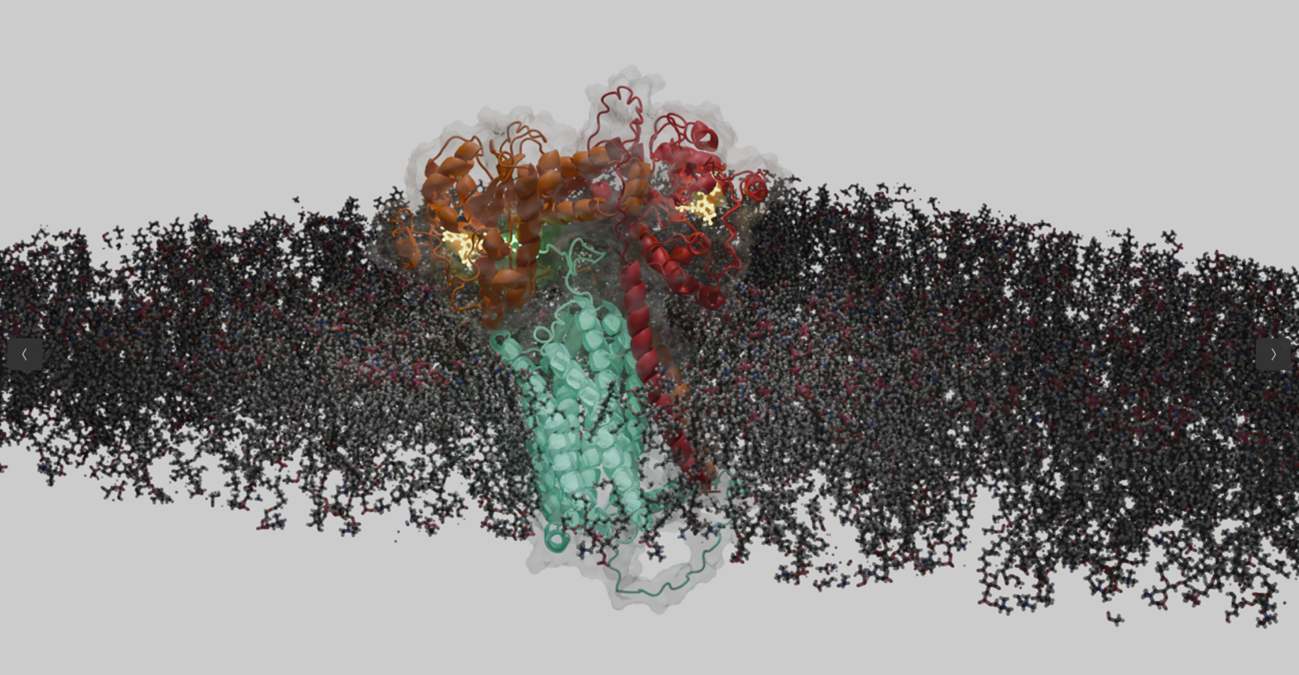
Figure 1. At the Golgi membrane, dimeric hTPST (orange and red) catalyzes tyrosine sulfation of the CCR5 receptor (cyan) using PAPS (yellow) as the sulfate donor.
Glossary
CCR5: C-C chemokine receptor type 5; a chemokine receptor expressed on the surface of human immune cells. It is involved in inflammation and immune-cell trafficking and is also known as a coreceptor used by HIV for cell entry.
Tyrosine sulfation: A post-translational modification in which a sulfo group is added to a tyrosine residue in a protein. This modification often regulates extracellular protein-protein interactions.
Figure2
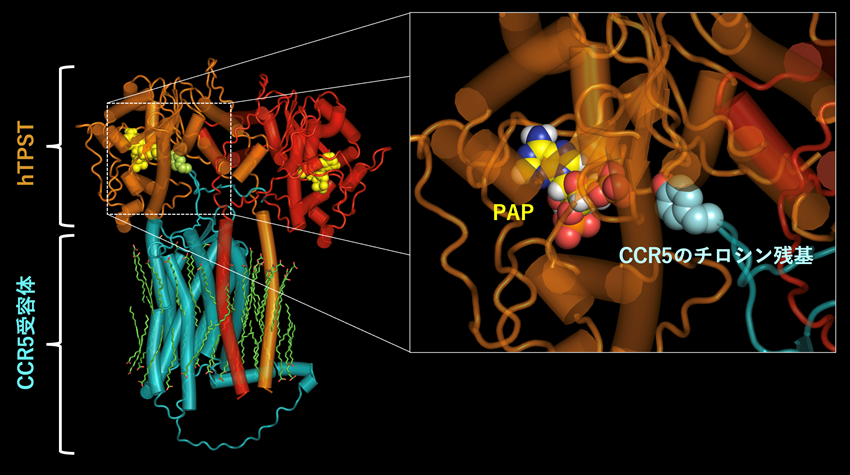
Figure 2. Left: structure-guided full-length model for hTPST-mediated CCR5 tyrosine sulfation. The hTPST1 dimer is shown in orange and red, the CCR5 receptor in cyan, and membrane-mimetic molecules in green. PAP is shown as yellow spheres, and the acceptor tyrosine residue of CCR5 is shown as cyan spheres. Right: close-up view of the active site in the complex. The tyrosine residue in the CCR5 N-terminal region is accommodated in the hTPST substrate-binding pocket and positioned near PAP.
Additional glossary
hTPST: Abbreviation for human tyrosylprotein sulfotransferase. hTPSTs are enzymes in the Golgi lumen that catalyze sulfation of tyrosine residues in proteins.
PAPS / PAP: PAPS (3'-phosphoadenosine 5'-phosphosulfate) is the sulfate donor, and PAP (3'-phosphoadenosine 5'-phosphate) is the reaction product generated after sulfate transfer. In this study, the structure of hTPST1 bound to PAP and a CCR5 peptide was analyzed.
X-ray crystallography: A method for determining the atomic-level three-dimensional structures of proteins and other molecules by irradiating crystals with X-rays and analyzing the resulting diffraction data.
Acknowledgements
This work was supported by JSPS KAKENHI (21K05384, 22H02262, 24K09353, 25H01276) and the Shorai Foundation for Science and Technology.
Publication information
| Journal | The FEBS Journal |
|---|---|
| Title | Structural insights into tyrosine sulfation of CCR5 by human tyrosylprotein sulfotransferase-1 |
| Authors | Shinnosuke Tanaka, Hirai Asano, Kota Toyoda, Toshiaki Nishiyori, Hidetaka Kojo, Kazuto Kiyomatsu, Katsuhisa Kurogi, Yoichi Sakakibara, Etsuko Nishimoto, Takamasa Teramoto and Yoshimitsu Kakuta* |
| * | Corresponding author |
| DOI | 10.1111/febs.70597 |
- For more details on this research, click here.
Contact
Assistant Professor Takamasa Teramoto
Associate Professor Etsuko Nishimoto
Professor Yoshimitsu Kakuta
Division of Applied Life Chemistry, Laboratory of Biophysical Chemistry
Faculty of Agriculture, Kyushu University