











 Contact
 Access Map


Research group led by Associate Professor Keisuke Ikegami discovers a new mechanism underlying nighttime elevation of intraocular pressure
Sympathetic nerve signaling induces RHOB and impairs the eye's drainage-system "cleaning" function, pointing to potential chronotherapy for glaucoma
Points
- Focused on noradrenaline, a signaling molecule of the sympathetic nervous system, as a potential mechanism underlying nighttime elevation of intraocular pressure
- Discovered that noradrenaline increases the expression of RHOB in the trabecular meshwork, the eye's drainage tissue
- RHOB may impair the cellular "cleaning" function of trabecular meshwork cells, thereby hindering the outflow of aqueous humor from the eye
- In mice, topical administration of a RHO/ROCK inhibitor suppressed nighttime elevation of intraocular pressure
- These findings may contribute to chronotherapy approaches that optimize the timing of glaucoma treatment and support the identification of new therapeutic targets
Abstract
Intraocular pressure (IOP) is the most important risk factor associated with the onset and progression of glaucoma (*1). IOP fluctuates throughout the day and is known to be higher at night in both humans and mice. However, the detailed molecular mechanisms by which changes in the outflow of aqueous humor (*2), the fluid inside the eye, contribute to nighttime IOP elevation have remained poorly understood.
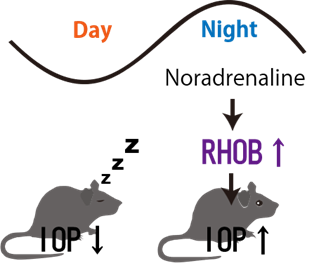
A research group led by Associate Professor Keisuke Ikegami of the Faculty of Agriculture, Kyushu University, building on work initiated during his tenure at Aichi Medical University, has revealed that noradrenaline (*3), a neurotransmitter released by the sympathetic nervous system, derived from the superior cervical ganglion increases the expression of the small GTPase RHOB (*5) in the trabecular meshwork (*4), the tissue responsible for draining aqueous humor from the eye. Increased RHOB levels appear to impair phagocytosis (*6), the cellular "cleaning" function by which trabecular meshwork cells engulf and process waste materials, potentially reducing aqueous humor outflow (Figure 1).
By comparing gene expression changes induced by noradrenaline in mouse eyes and human trabecular meshwork cells, the researchers identified RHOB as a gene commonly upregulated in both systems.They further demonstrated that noradrenaline enhances RHOB expression through the cAMP-CREB signaling pathway (*7). In trabecular meshwork cells lacking RHOB, phagocytic activity was increased, whereas RHOB overexpression reduced both phagocytosis and the permeability of trabecular meshwork cell layers, an in vitro measure related to aqueous humor outflow. In mice, eye drops containing an inhibitor of the RHO/ROCK pathway (*8) suppressed both nighttime IOP elevation and noradrenaline-induced increases in IOP (Figure 1).
This study provides a new framework for understanding nighttime IOP elevation through the "sympathetic nervous system-RHOB-trabecular meshwork cleaning function" axis. In the future, these findings may contribute to chronotherapy strategies that optimize the timing of glaucoma medication administration, as well as to the development of novel approaches for regulating circadian IOP rhythms by targeting RHOB.
The findings were published online in advance on July 16, 2026 (JST), in Communications Biology, an international scientific journal published by Springer Nature.
Researcher's Comment
Intraocular pressure fluctuates considerably over the course of a day. In this study, we identified a molecular pathway through which the sympathetic nervous system alters cellular functions in the eye's drainage pathway, providing a mechanism for nighttime elevation of intraocular pressure. We hope these findings will improve our understanding of the relationship between circadian changes in intraocular pressure and glaucoma, and ultimately help optimize the timing of glaucoma treatment.
(Keisuke Ikegami)
Glossary
*1 Glaucoma
A disease in which damage to the optic nerve gradually leads to loss of visual field. Elevated intraocular pressure is the most important risk factor for glaucoma, and treatments primarily focus on lowering intraocular pressure.
*2 Aqueous humor
A transparent fluid that fills the interior of the eye. It is produced by the ciliary body and drained through the trabecular meshwork and other outflow pathways. The balance between aqueous humor production and outflow determines intraocular pressure.
*3 Noradrenaline (norepinephrine)
A neurotransmitter released by the sympathetic nervous system. It plays important roles in regulating physiological functions such as arousal, heart rate, and blood pressure. In this study, noradrenaline was identified as a signaling molecule that contributes to nighttime elevation of intraocular pressure.
*4 Trabecular meshwork
A tissue located within the eye's primary aqueous humor drainage pathway. It plays a critical role in the regulation of intraocular pressure and is one of the major therapeutic targets for glaucoma treatment.
*5 RHOB
One of the small GTPases that functions as a molecular switch in intracellular signaling. RHOB is involved in regulating various cellular processes, including cell shape, adhesion, movement, and the uptake of extracellular materials. In this study, RHOB was identified as a molecule that suppresses phagocytosis in trabecular meshwork cells.
*6 Phagocytosis
A cellular process in which cells engulf and digest surrounding particles, debris, and waste materials. In the trabecular meshwork, phagocytosis is thought to serve as a "cleaning" function that helps maintain the aqueous humor drainage pathway and supports normal outflow.
*7 cAMP-CREB signaling pathway
A major signaling pathway that transmits extracellular stimuli to changes in gene expression within cells. When intracellular cAMP levels increase, the transcription factor CREB becomes activated and regulates the expression of specific target genes. This study also reveals a previously unrecognized mechanism by which RHOB expression is regulated through the cAMP-CREB signaling pathway.
*8 RHO/ROCK signaling pathway
A signaling pathway that regulates cellular processes such as cell shape, stiffness, contractility, and adhesion. ROCK inhibitors are currently used as glaucoma medications to lower intraocular pressure by improving aqueous humor outflow. A key finding of this study is that nighttime intraocular pressure elevation is associated not simply with activation of the RHO/ROCK pathway, but with an increase in the expression of RHOB, an upstream regulator of the pathway.
Publication Information
Journal: Communications Biology
Title: Norepinephrine-induced small GTPase RHOB mediates nocturnal intraocular pressure rise in mice
Authors: Keisuke Ikegami, Takumi Takahashi, Yuto Katamoto, Atsuro Oishi, Akihide Yoshimi, Miki Nagase, Atsuya Miki, Shinobu Yasuo, Satoru Masubuchi
DOI: 10.1038/s42003-026-10710-1
- For more details on this research, click here.
For Research-related inquiries