











 Contact
 Access Map


Professor Takahiro Nakamura and his research team have developed a novel RNA editing technology called "RECODE."
Accurate conversion of targeted RNA cytidine (C) to uridine (U): functionality demonstrated in animal cells and mice.
Points
- Repairing mutations at the RNA level could enable safe treatment of various diseases. However, existing technologies for converting cytidine (C) to uridine (U) in RNA suffer from low editing efficiency.
- Developed a technology that enables the precise conversion of a single targeted RNA base in living organisms. Achieves higher efficiency and fewer errors compared to conventional methods.
- Future development aimed at treating actual diseases is expected to establish this technology as a new gene therapy platform.
Abstract
Living organisms function using DNA, which serves as a blueprint, and RNA, which acts as a copy of that blueprint. Both DNA and RNA store information as sequences of the "letters" A, C, G, and U (or T), and even a single-letter difference can cause disease. Correcting such "typos" could greatly advance our understanding of diseases and their treatment. However, accurately replacing just one specific letter inside a cell is far from easy.
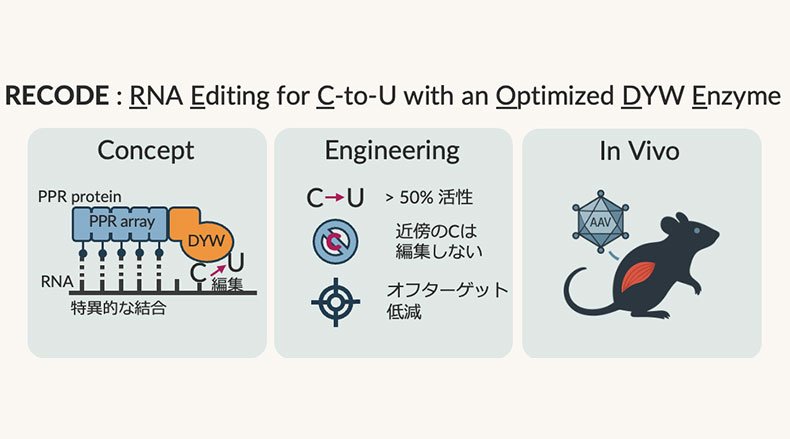
In this study, Professor Takahiro Nakamura of the Faculty of Agriculture, Kyushu University, together with researchers from EditForce, Inc., developed a new method called RECODE to replace the letter C in RNA with U, inspired by a mechanism discovered in plants. RECODE is designed as a single protein that combines two functional components: a "reading module" (PPR protein*¹) that precisely binds to the target RNA sequence, and an "editing module" (DYW domain) that converts C to U at the bound site. A key feature of RECODE is that it does not require auxiliary molecules such as guide RNAs; the engineered protein alone can accurately change a specified site from C to U.
When tested in human cultured cells, RECODE successfully rewrote only the targeted single letter. Furthermore, in experiments where RECODE was delivered to mice using adeno-associated virus (AAV) as a carrier, RNA editing*² was confirmed to occur in tissues such as muscle. This demonstrates a significant advance: the engineered molecule functions not only in cells but also within living organisms.
RECODE is designed to selectively convert only the intended cytidine (C) to uridine (U) without affecting nearby Cs. Moreover, because it edits RNA--the copy of the blueprint--rather than DNA itself, the changes are temporary and reversible, allowing the original state to be restored when needed. Moving forward, the research team will work to minimize unintended edits (off-target effects) and evaluate long-term behavior in vivo, advancing toward medical applications.
This achievement was published in the academic journal Nucleic Acids Research on Monday, December 8, 2025.
Glossary
(*¹) PPR Protein
PPR (Pentatricopeptide Repeat) proteins are RNA-binding proteins originally discovered in plants.
(*²) RNA Editing
A process in which specific bases in RNA are enzymatically converted into different bases.
Publication Information
Journal: Nucleic Acid Research
Title: RECODE: A programmable guide-free C-to-U RNA editing tool
Authors: Mizuho Ichinose, Masaru Ohta, Yasuka Shimajiri, Yumi Akaiwa, Izumi Nakamura, Miki Shimamoto, Riyo Makinoda, Soichi Ozaki, Takayuki Tamai, Nana Maekawa, Minori Tonomoto, Takahiro Nakamura, Yusuke Yagi, Bernard Gutmann
DOI:10.1093/nar/gkaf1309
- For more details on this research, click here.
For Research-related inquiries