











 Contact
 Access Map


Professor Katsumi Doi and his research team are the first in the world to demonstrate that oxygen-tolerant lactic acid bacteria produce plasmalogens, key components for brain health
Plasmalogens are involved in bacterial evolution and stress tolerance; successful production under oxygen conditions opens new possibilities for dementia prevention and applications in fermented foods
Points
- Plasmalogens (Note 1), which are expected to help maintain and improve brain health-one of the major challenges in an aging society-have lacked a simple and cost-effective production method.
- In this study, we were the first in the world to demonstrate that plasmalogens can be produced by facultative anaerobic bacteria such as lactic acid bacteria, and we partially elucidated the underlying mechanism.
- In the future, it is expected that plasmalogens, which can help suppress age-related disorders, will become easily and affordably available for consumption.
Abstract
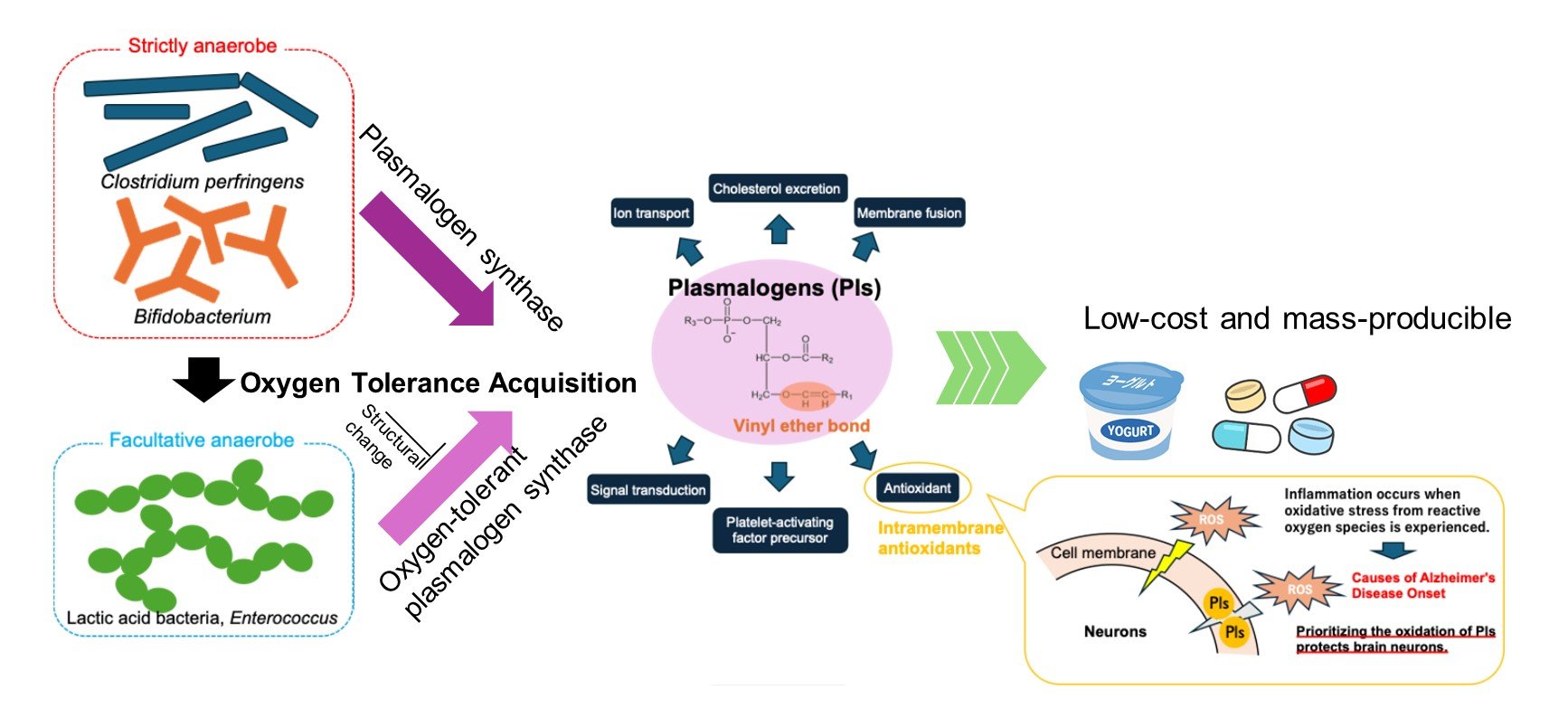
Plasmalogens are a type of phospholipid abundantly found in the brain, heart, and other tissues, and they play an essential role in antioxidant activity and stabilizing cell membranes. A decrease in plasmalogen levels has been reported in patients with Alzheimer's disease, raising expectations for supplementation therapy. However, until now, plasmalogens have been obtained mainly from marine products or animal tissues, making high costs a significant challenge. Biologically, they were also believed to exist only in strict anaerobic bacteria such as Clostridium perfringens (Note 2), which cannot tolerate oxygen.
A research group led by Professor Katsumi Doi of the Faculty of Agriculture and Professor Masanori Honsho of the Faculty of Medical Sciences at Kyushu University has, for the first time in the world, demonstrated that plasmalogens can be produced by facultative anaerobic bacteria, such as lactic acid bacteria, which are capable of surviving in the presence of oxygen. Furthermore, the team revealed that PlsA, the plasmalogen-synthase in facultative anaerobic bacteria, possesses a unique protein structure that enables it to avoid oxygen stress. This finding suggests that bacteria may have acquired the ability to synthesize plasmalogens during the evolutionary process of adapting to oxygen-rich environments.
The research group detected plasmalogens in 11 strains, including lactic acid bacteria and enterococci. Among them, when the plsA gene from Lactococcus cremoris was introduced into Escherichia coli, the recombinant E. coli acquired the ability to synthesize plasmalogens even under oxygen-rich conditions and exhibited increased resistance to both oxygen stress and high-salt environments (osmotic stress, Note 3). Structural analysis revealed that the C-terminal region of this PlsA enzyme contains an α-helix (Note 4) that protects its iron-sulfur cluster ([4Fe-4S]) from oxidation. This structural feature is considered an important evolutionary adaptation for acquiring tolerance to oxygen environments.
This study is the first to show that plasmalogens, which play a functional role in human brain health, are key molecules for bacterial adaptation and evolution in oxygen environments. Furthermore, by establishing a fermentation system that enables the intake of food-derived lactic acid bacteria and large-scale production under aerobic conditions using E. coli, this research lays the foundation for a novel biotechnology process that allows plasmalogens to be produced safely and at low cost. In near future, applications are expected in dementia-preventive foods, pharmaceuticals, and even research on microbial evolution.
This research was published in the journal Applied and Environmental Microbiology of the American Society for Microbiology on December 22, 2025 (Japan time).
Researcher's Comment
It is highly intriguing that plasmalogens not only help maintain brain health but also serve as a "key to evolution" for bacteria adapting to oxygen-containing environments. Harnessing the power of microorganisms, we aim to develop biotechnology-based products that are friendly to both humans and the planet-particularly foods and pharmaceuticals that can contribute to an aging society.
(Professor Katsumi Doi)
Glossary
(Note 1) Plasmalogens
Plasmalogens are lipid components that constitute biological membranes in a wide range of organisms, from microorganisms to animals. In the human body, they account for approximately 18% of total phospholipids. In mammals, plasmalogens are distributed in a tissue-specific manner and are particularly abundant in the brain, cardiac muscle, kidneys, and leukocytes. They are known to play various physiological roles, including antioxidant activity, signal transduction, and ion transport.
(Note 2) Anaerobic Bacteria
Anaerobic bacteria are a general term for bacteria that do not require oxygen for growth. They are classified into two types:
Facultative anaerobic bacteria (e.g., lactic acid bacteria, Escherichia coli, enterococci), which can grow even in the presence of oxygen.
Obligate anaerobic bacteria (e.g., bifidobacteria, Clostridium perfringens), which die when exposed to atmospheric levels of oxygen.
(Note 3) Osmotic Stress
Osmotic stress refers to the stress experienced by cells when the osmotic pressure around them changes abruptly, causing water to move in or out of the cell and impairing cellular functions. Under high osmotic pressure, cells lose water and shrink, while under low osmotic pressure, excessive water enters the cell, causing it to swell. To cope with this stress, cells possess mechanisms to regulate osmotic pressure.
(Note 4) α-Helix
An α-helix is a structural motif in which a single polypeptide chain is tightly coiled into a regular right-handed spiral, determined by the characteristic arrangement of amino acids over a specific length.
Publication Information
Journal: Applied and Environmental Microbiology
Title: Characterization of plasmalogen production in facultative anaerobic bacteria and aerobic synthesis in recombinant Escherichia coli expressing anaerobic bacteria-derived plasmalogen synthase genes
Authors: Rei Irimajiri, Meimi Kuwabara, Yohei Ishibashi, Sakurako Ano, Yasuhiro Fujino, Masanori Honsho, Katsuya Fukami, Shiro Mawatari, Takehiko Fujino, Katsumi Doi
DOI:10.1128/aem.00940-25
- For more details on this research, click here.
For Research-related inquiries