











 Contact
 Access Map


Research Group Led by Assistant Professor HyunJung Bang Advances International Collaborative Learning in Agriculture through "COIL+"
Evaluating the Impact of Cross-Border Learning on Sustainability Awareness, Action, and Collaborative Competencies
Points
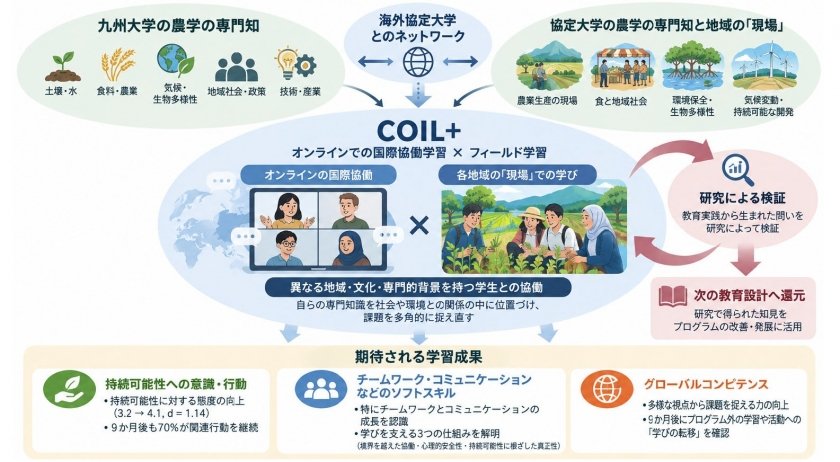
- We implemented COIL+ 1,2, an international collaborative learning model that enables students to explore agricultural challenges, including food production, environmental issues, and climate change, from cross-border perspectives in partnership with overseas universities.
- Tracking students' learning outcomes revealed not only positive changes in their awareness of and actions toward sustainability, but also students' perceived development in teamwork, communication, and other essential skills. The study also identified three key mechanisms that support and enhance these learning experiences.
- In future research, we aim to identify the educational conditions that enable encounters with students from different countries and regions to develop into meaningful learning experiences, and to establish instructional design principles that can be applied to international collaborative learning3 in agriculture.
Abstract
Agriculture encompasses a wide range of issues concerning the relationship between human society and the environment, including food production, soil, water, climate, and biodiversity. While these challenges manifest differently across regions, they are also interconnected beyond national borders through global issues such as climate change and food security. Therefore, it is important for students to learn how to understand these challenges by comparing knowledge and experiences from different regions.
A research group led by Assistant Professor HyunJung Bang of the Faculty of Agriculture, Kyushu University, has been developing COIL+, an international collaborative learning model that combines online international collaborative learning with field-based learning in local communities through partnerships with overseas universities. The research group has now published two studies that examined the learning outcomes of students who participated in COIL+ from different perspectives.
The first study surveyed 19 students from Japan and South Korea. The mean score for attitudes toward sustainability increased from 3.2 before participation to 4.1 after participation, demonstrating a large effect size (Cohen's d = 1.14). In addition, 70% of participants were still engaging in sustainability-related activities nine months after completing the program.
The second study analyzed the development of soft skills and global competence4 across three COIL+ programs conducted between 2022 and 2024. Students reported particularly strong growth in teamwork and communication skills. The study also identified three key mechanisms that supported these learning outcomes and documented students' reported application of their learning5 beyond the program nine months after participation.
This initiative has continuously examined questions emerging from educational practice through research and applied the resulting insights to the design of subsequent learning programs. Moving forward, the research team aims to investigate the conditions under which encounters across national and regional boundaries develop into meaningful learning experiences and to establish instructional design principles for international collaborative learning in agriculture.
These research findings were published as two papers in the journal International Journal of Sustainability in Higher Education on April 22, 2026, and August 14, 2026.
The COIL+ Learning Environment: Connecting Agricultural Expertise with Local Field Contexts Across Regions
Researcher's Comment
Agricultural challenges take different forms depending on the natural environments and social conditions of each region. Yet many of these challenges are interconnected across national borders. By sharing and examining their respective local contexts, students from different regions can reconsider issues they once took for granted from new perspectives. We hope to further develop COIL+ as a learning environment that fosters such inquiry, reflection, and collaborative learning.
(HyunJung Bang)
Glossary
(Note 1) COIL (Collaborative Online International Learning)
An educational approach in which students from universities in different countries and regions learn collaboratively through online interaction.
(Note 2) COIL+
COIL+ is an international collaborative learning model that combines online international collaborative learning through COIL with field-based learning in local communities. In this initiative, the agricultural expertise of participating universities and their local field contexts are integrated as shared learning resources.
(Note 3) International Co-Learning
International collaborative learning is an educational approach in which students from different linguistic, cultural, and educational backgrounds learn together and utilize these differences themselves as valuable learning resources.
(Note 4) Global Competence
Global competence refers to the ability to understand different cultural and social backgrounds, critically examine issues from multiple perspectives, and collaborate effectively with people from diverse backgrounds.
(Note 5) Transfer of Learning
Transfer of learning refers to the application of knowledge and skills acquired in one learning environment to different contexts, such as other learning settings, activities, or real-life situations.
Publication Information
Paper 1
Journal: International Journal of Sustainability in Higher Education
Title: COIL+: Enhancing Sustainability Competencies in Higher Education through Experiential and Problem-Based Learning
Author: HyunJung Bang
DOI: 10.1108/IJSHE-03-2025-0178
Paper 2
Journal: International Journal of Sustainability in Higher Education
Title: COIL+: Integrating Experiential and Blended Learning to Advance Soft Skills and Global Competence in Sustainability Education
Author: Abrianna Elke Chairil, HyunJung Bang, David M. Rosch
DOI: 10.1108/IJSHE-10-2025-1256
- For more details on this research, click here.
For Research-related inquiries