











 Contact
 Access Map


[Topics] Smarter Loading, Fresher Produce―Loading Position Matters: Developing Data-Driven Guidelines for Preserving Produce Quality
Fresh fruits and vegetables are highly sensitive to temperature, humidity, and where they are placed during transportation. However, loading practices have often relied on experience rather than clear scientific guidelines.
As part of the BRiDGE program (Bridging R&D and Society 5.0) supported by Japan's Ministry of Agriculture, Forestry and Fisheries, a research team led by Kyushu University conducted detailed measurements of temperature, humidity, and vibration during transport by trucks, trains, and ships. The study revealed that even under the same conditions, the degree of quality deterioration varies greatly depending on the loading position.
The researchers developed a method to estimate quality loss by combining environmental dryness with commodity-specific susceptibility to moisture loss. This enables more rational loading strategies, placing fragile products in less stressful locations.
Importantly, these findings have been organized into a practical "quality risk map" and a user-friendly loading manual, allowing practitioners to easily understand and apply optimal loading strategies.
In international shipping experiments, the study demonstrated that differences in loading alone can determine whether products retain their commercial value. This approach does not require special equipment and can be readily implemented. We encourage practitioners to use this manual to improve loading practices, reduce food loss, and maintain product quality.
Figure. Optimizing Fresh Produce Loading and Quality Preservation Using a Quality Risk Map
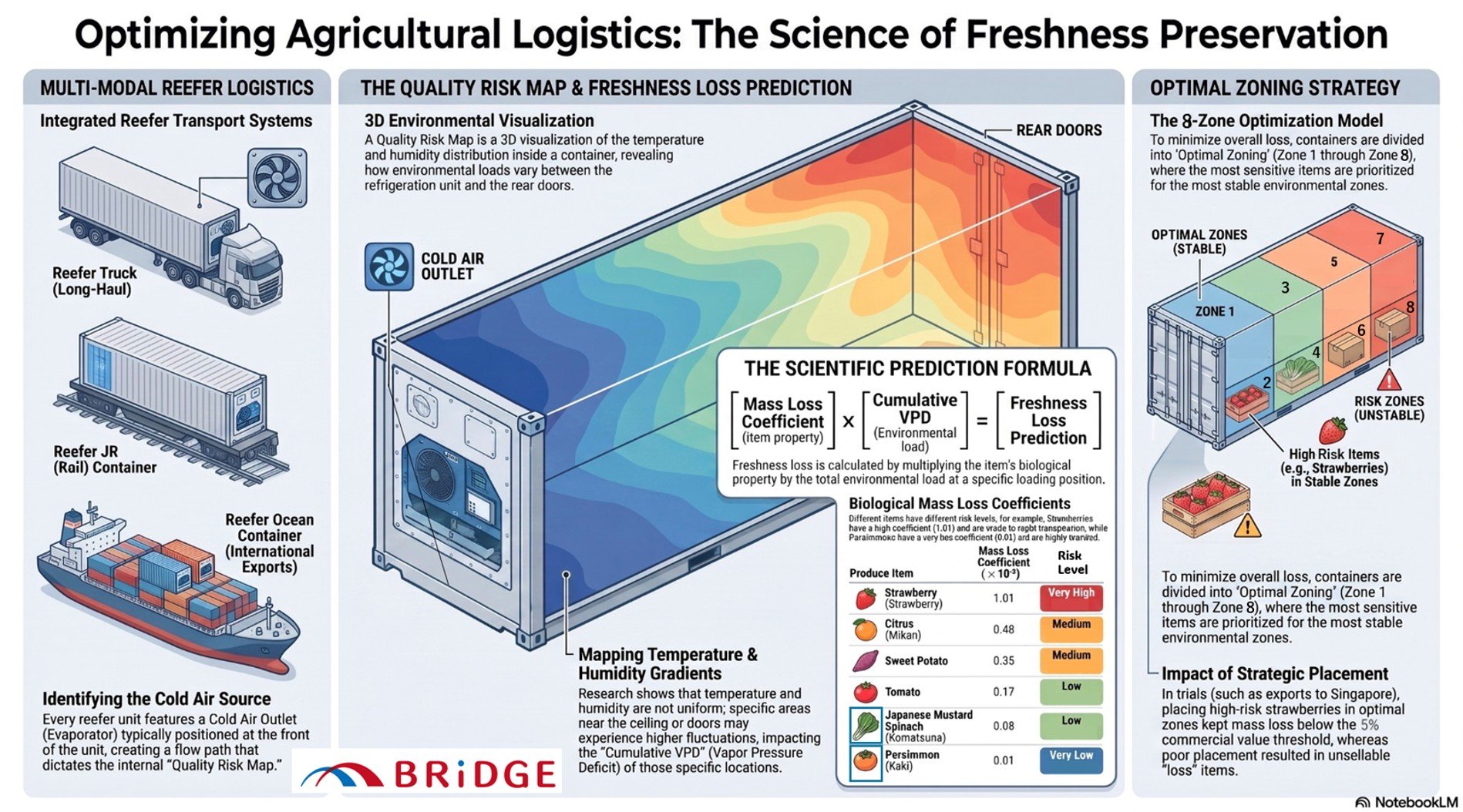
This conceptual diagram illustrates how quality risks within transport containers can be visualized using temperature, humidity, and vibration data collected during truck, rail, and maritime transportation. The quality risk map identifies locations where produce is more susceptible to deterioration and recommends optimal loading positions for different commodities. By applying the quality risk map, transport operators can maintain product quality during transit while reducing freshness loss and food waste.
For Research-related inquiries
Fumihiko Tanaka, Professor
Fumina Tanaka, Associate Professor
Loading Manual for Reducing Quality Loss in Fresh Produce Transportation