











 Contact
 Access Map


[Topics] Professor Emeritus Takahisa Miyamoto receives the 2026 Award of the Japan Association of Food Preservation Science
Professor Emeritus Takahisa Miyamoto has received the 2026 Award of the Japan Association of Food Preservation Science. He was recognized for his research achievements entitled "Studies on Microbial Contamination of Fresh Produce and Its Control."
About the Japan Association of Food Preservation Science and its Award
The Japan Association of Food Preservation Science was established in 1975 as the Japan Cold Chain Research Association. Its mission is to promote both fundamental and applied research on the low-temperature preservation of foods, advance technologies related to food production, storage, processing, and distribution, and improve equipment used in these fields, thereby contributing to more efficient food distribution and a stable food supply.
In 1987, the organization expanded and was renamed the Japan Society of Food Preservation at Low Temperature. It was subsequently recognized as an academic organization registered with the Science Council of Japan and grew to a membership of approximately 3,000.
In response to the expanding field of food preservation and advances in science and technology, the society adopted its current name, the Japan Association of Food Preservation Science, in 1997. Since then, it has continued to address emerging societal needs in the area of food preservation.
The Association Award is presented to individuals who have made particularly outstanding research achievements in fields that contribute to the objectives of the association.
Research Overview
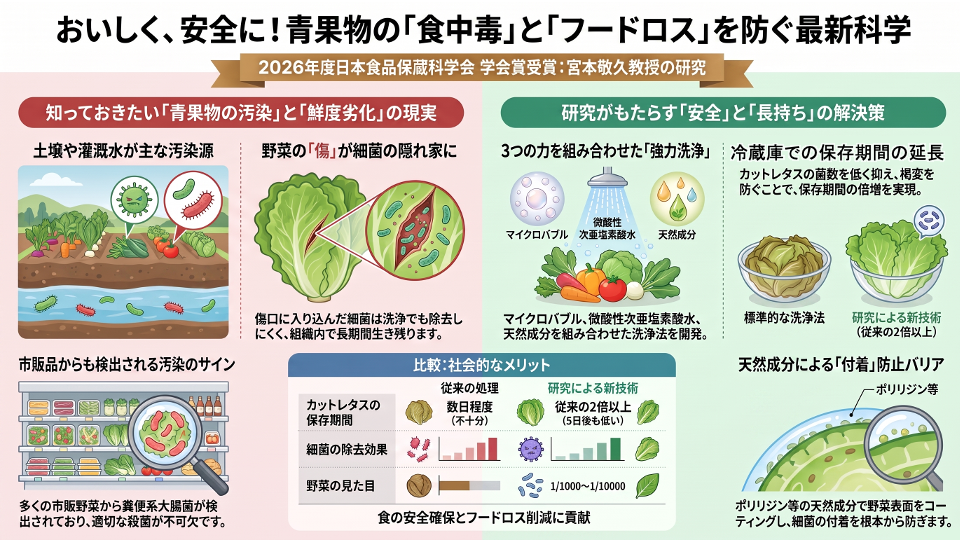
The award-winning research, entitled "Studies on Microbial Contamination of Fresh Produce and Its Control," focused on developing technologies to protect fruits and vegetables from foodborne pathogens and ensure their safety for consumption. The research produced three major achievements:
- Clarifying how contamination occurs
The study demonstrated that food-borne pathogens present in soil rarely enter vegetables through their roots. However, when fruits or vegetables are damaged, bacteria can penetrate through wounds and survive inside the produce for extended periods. The findings highlight the importance of preventing physical damage and using mulch or protective covers to reduce contamination caused by soil splashing. - Developing novel decontamination methods
Rather than relying on a single treatment, the research successfully combined safe sanitizing solutions with microbubbles and naturally occurring compounds found in green and black tea. This approach dramatically reduced microbial contamination while maintaining the freshness and quality of produce. - Preventing bacterial attachment and biofilm formation
The study also developed methods to inhibit the formation of biofilms--protective microbial layers that enable food-borne pathogens to adhere firmly to produce and food-processing equipment. By using specific safe compounds, the researchers were able to prevent bacterial attachment and biofilm development effectively.
For Research-related inquiries
- Food Hygienic Chemistry Website
- Professor Emeritus Takahisa Miyamoto
Researchmap: https://researchmap.jp/read0172327
J-GLOBAL: https://jglobal.jst.go.jp/detail?JGLOBAL_ID=200901038220219408 - Japan Association of Food Preservation Science Website