











 Contact
 Access Map


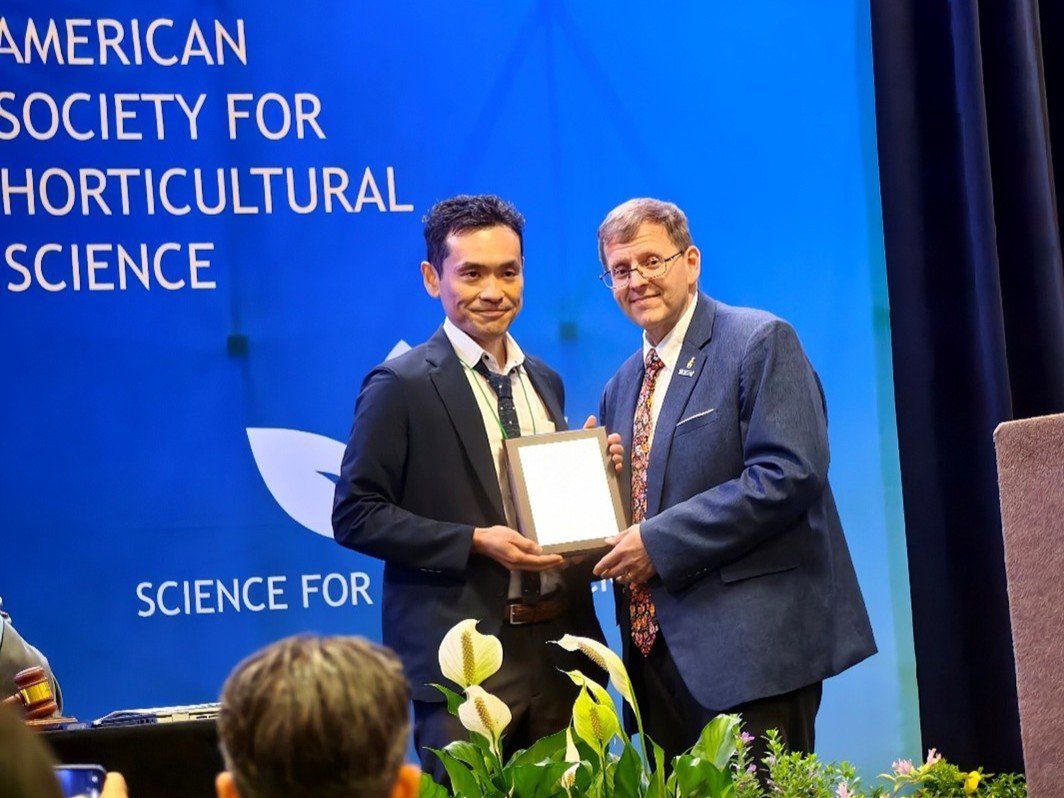
[Topics] A Paper by Associate Professor Daisuke Yasutake and Colleagues Receive the 2026 Outstanding Controlled Environment Publication Award from the American Society for Horticultural Science (ASHS)! (August 6, ASHS Annual Conference, Dallas, Texas)
Award-Winning Paper
Title: Combining hyperspectral imaging and a transparent hydroponics bed to analyze growth and age distribution dynamics of entire root systems in leafy vegetables under in-situ production conditions
Authors: Jin Z., Yasutake D., Sago Y., Iwao T., Yokoyama G. and Hirota T.
Journal: HortScience
DOI:https://doi.org/10.21273/HORTSCI18327-24
Outstanding Controlled Environment Publication Award
The ASHS Outstanding Controlled Environment Publication Award is presented annually to the author(s) of the most outstanding paper related to controlled environment agriculture published in the previous year's issues of ASHS journals. Papers are evaluated based on five key criteria: (1) clarity and purpose of research objectives, (2) technical quality including accuracy and methodology, (3) usefulness and relevance to horticultural science and industry, (4) originality and innovation of the research approach, and (5) potential impact on future research and real-world applications. A screening committee of five members appointed by the ASHS President-elect conducts a rigorous multi-stage review process to select the winning paper.
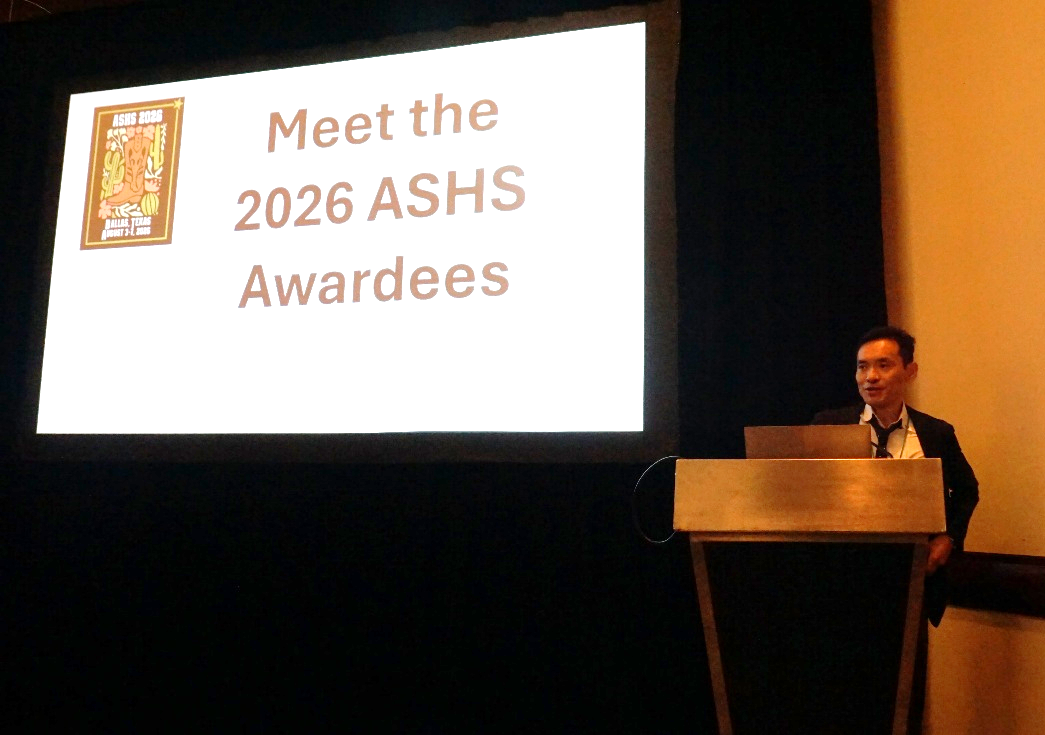
The award was formally presented at the ASHS Annual Conference held in Dallas in 2026.
Paper Overview
Plant roots are vital organs that play essential roles in crop production, including water and nutrient absorption and the storage of photosynthetic products. However, direct observation of roots under actual production conditions has been difficult because they are hidden beneath the cultivation medium. In this study, we developed a novel method for non-destructive observation of entire root systems by modifying the cultivation bed of a nutrient film technique hydroponic system with transparent materials and imaging the roots from below using a hyperspectral camera*. Using spinach as the plant material, daily images were acquired from sowing to harvest, and the reflectance ratio at 498 nm and 601 nm (R601/R498) was identified as the optimal index for estimating root age. Furthermore, this index was successfully applied to visualize the age distribution of the entire root system as false-color images throughout the cultivation period, marking the world's first achievement of this kind. This method is expected to contribute to the evaluation of root health and precision crop management in controlled environment agriculture, such as plant factories.
A press release on this paper was also issued by ASHS upon its publication in HortScience.
URL: https://ashs.org/news/699843/New-Research-on-Hyperspectral-Imaging-and-Transparent-Hydroponics-for-Leafy-Vegetable-Root-Analysis.htm
Glossary
* hyperspectral camera
A specialized camera capable of recording light reflected from objects across hundreds of narrow wavelength bands simultaneously. Unlike conventional color cameras, which capture information in only three color bands (red, green, and blue), a hyperspectral camera acquires detailed spectral information across hundreds of wavelength bands, enabling the objective and non-destructive detection of subtle physical and chemical properties that are invisible to the human eye. This technology is increasingly being applied across a wide range of fields, including agriculture, food science, and medicine.
Comments from the Award Recipients
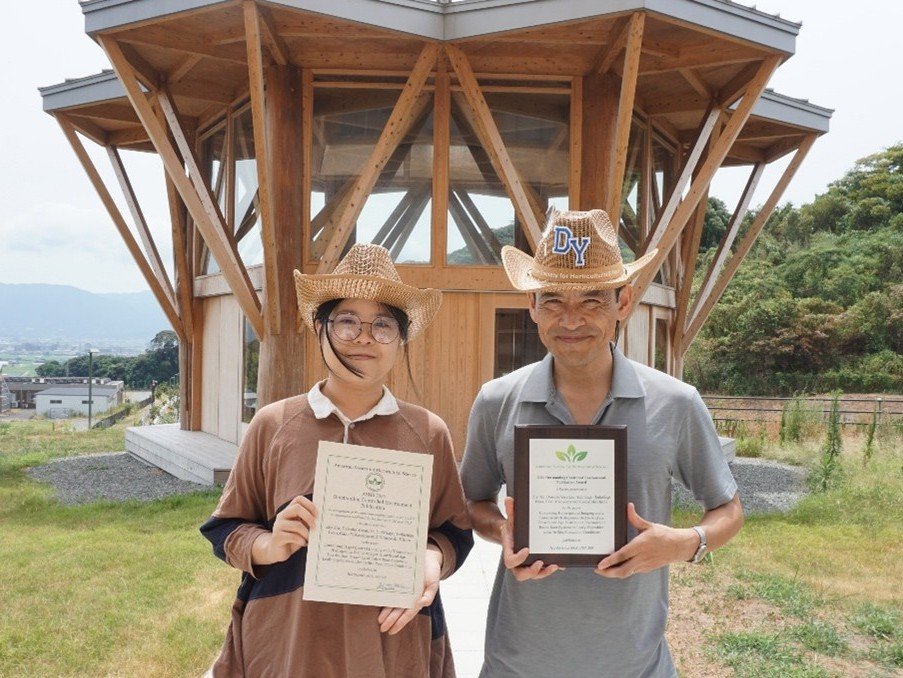
I am deeply pleased and surprised to learn that our first milestone paper on root monitoring research for the "Hidden half" of plants, written with my Ph.D. student Mr. Jin as the first author, has been recognized with an award from ASHS, an organization with over 120 years of tradition. I must confess that when the award notification email from ASHS first arrived, I was not entirely sure it was genuine.
Building on this paper, our root monitoring research continues to advance further (https://ag.kyushu-u.ac.jp/english/research/c06/a-research-group-led-by-associate-professor-daisuke-yasutake-has-developed-the-worlds-first-technolo/), and I am determined to transform the "Hidden half" into the "Visible half" -- making the once-invisible world of roots fully understood and accessible.
(Daisuke Yasutake)
I am deeply honored to receive such a prestigious award. I am overjoyed and truly grateful that the very first research project I undertook after joining the lab has been recognized in this way. When I was first notified of the award, I could hardly believe it, but once it sank in, I felt an incredible sense of accomplishment.
I would like to express my heartfelt gratitude to Prof. Yasutake for his continuous guidance, as well as to my co-authors and lab members who supported me throughout the experiments and the paper writing process. Encouraged by this honor, I will continue to work hard to advance root system monitoring technology.
(Ziyi Jin)